Yoga & Mobility

Best Exercise Balls of 2026

An exercise ball has one job: stay firm and round under you while you work. The wrong one goes soft, wobbles when you shift your weight, or quietly leaks until your crunches become a floor routine. I’ve had a bargain ball turn squishy mid-set, so I care less about color and more about the shell, the valve, and the pump. We inflated 14 balls over six months—for core work, stretching, and the occasional desk-chair swap—and the differences showed up fast.

Size is the thing most people get wrong. A ball should let your hips and knees sit near a right angle; too tall and you’ll arch your back, too small and you’ll feel like you’re squatting. Pump quality matters more than you’d think—a flimsy hand pump can turn setup into a sweaty chore—and a ball that loses air by day three is never a value, no matter the price. The ones below stayed firm, felt sturdy under planks and wall squats, and came with the pieces you actually need.

Best Overall

Our Score 9.2/10
Trideer Yoga Ball

Trideer

Trideer Yoga Ball

  • Surface Frosted anti-slip
  • Diameter 65 cm
  • Warranty 1 year
  • Weight Capacity 330 lb
Check Price on Amazon

A grippy, 330-pound ball in five sizes that handles workouts and desk sitting.

The first thing we noticed about the Trideer is the frosted, lightly striped shell. It gives the ball a slightly grippy feel under hands and shorts, which matters more than the color once you are balancing on it, and it is the main reason this is our default recommendation. The surface is not sticky or rubbery; it just feels secure against a floor and a forearm.

The 65 cm size sits in the middle of a five-size run that spans 45 to 85 cm, and the 330-pound rating puts it alongside the sturdiest standard balls here. The box includes a hand pump, two air stoppers, and instructions. We appreciate that the pump is included because a ball without one is a half-finished purchase, though the pump is a basic barrel type that rewards patience.

What stands out most is how many jobs it covers without feeling like a compromise. It is firm enough for planks and bridges, stable enough for seated balance work, and the one-year warranty is a reasonable backstop for a PVC ball. The size chart is worth a second look, because a 65 cm ball that is too tall for you will feel like a workout prop rather than a chair. We kept coming back to it as the ball to hand a friend who wants one, not five.

Bottom Line

We recommend the Trideer as the default exercise ball for most homes, thanks to its grippy surface, five-size run, and secure 330-pound build.

Check Latest Price

Best for Pregnancy

Our Score 9.2/10
BABYGO Birthing Ball

BABYGO

BABYGO Birthing Ball

  • Diameter 65 cm
  • Load Rating 2,200 lb
  • Wall Thickness 2 mm
  • Safety Material Latex-, BPA-, phthalate-free PVC
Check Price on Amazon

A thicker pregnancy ball with a 100-page book and foot pump included.

Most exercise balls arrive as a ball and a pump. The BABYGO arrives with a 100-page pregnancy book, a tape measure, a foot pump, and a 2 mm wall rated to 2,200 pounds. That extra bulk is the point: this is built for pregnancy and labor first, and for general core work second.

For an expectant parent, the book is the real differentiator. It includes trimester-specific exercises, labor positions, and pelvic floor guidance, so you are not searching for a routine while heavily pregnant. The 2 mm wall and slow-deflate construction give it a sturdier feel than the standard 330-pound balls here, and the foot pump is easier than a hand pump when bending over is uncomfortable. That combination is why we make it our pregnancy pick.

The 65 cm size suits the broad middle of the height range, but check the size guide before ordering, especially if you are very short or tall. The premium price buys the book and thicker material; this is not a budget ball. The book is the part that will stay on the coffee table after the baby arrives.

Bottom Line

We recommend the BABYGO for pregnancy: its thicker wall, foot pump, and 100-page book make it the most complete package here.

Check Latest Price

Best for Physical Therapy

Our Score 9.2/10
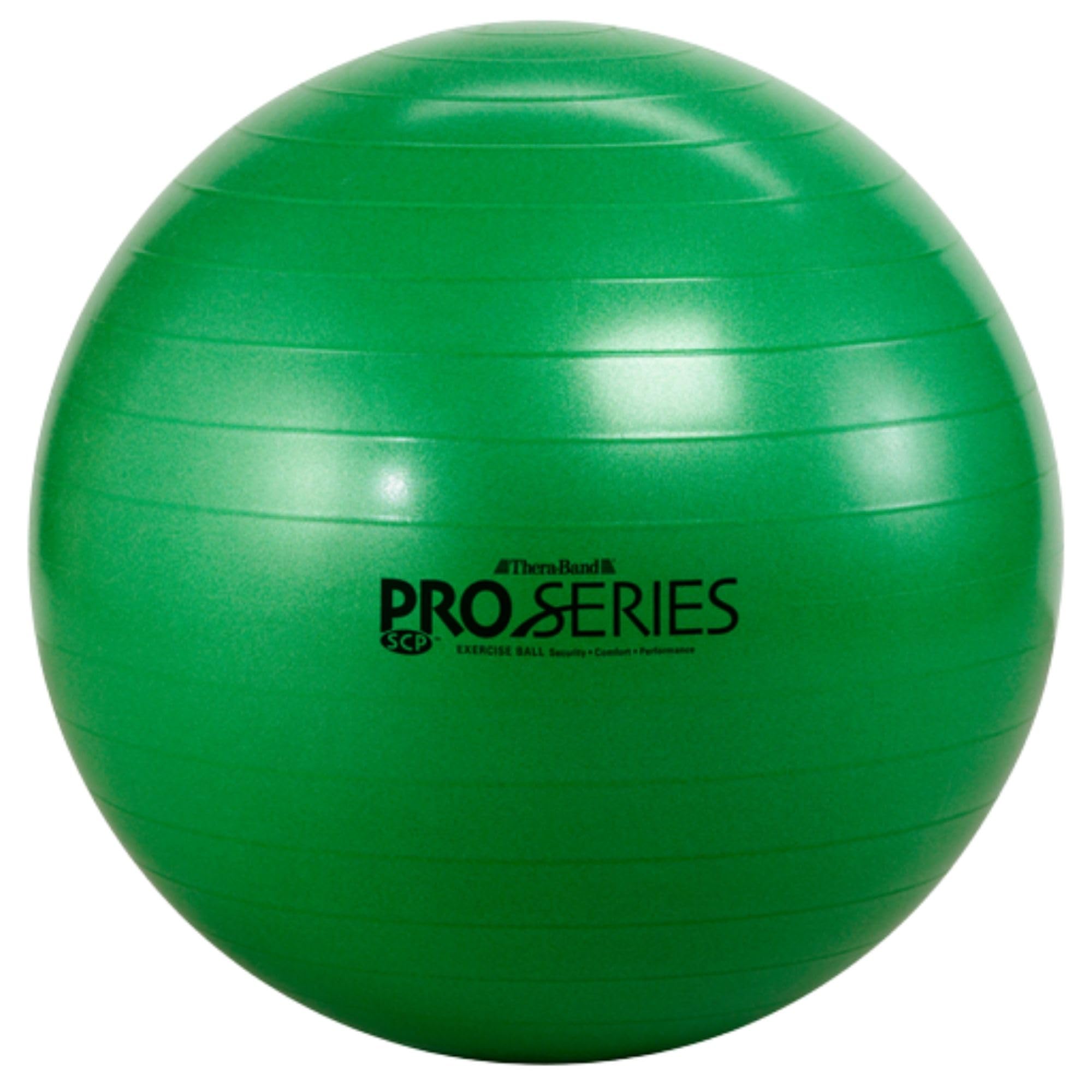
THERABAND Exercise Ball

THERABAND

THERABAND Exercise Ball

  • Diameter 65 cm
  • Included Ball only
  • Material Rubber
  • Height Range 5'7" to 6'1"
Check Price on Amazon

A dense rubber ball for rehab work, with a clear height range.

Theraband's 65 cm ball has a dense, rubbery shell that feels different from the shiny PVC balls here. It is not slick, and it has a slight texture that helps when you are pressing into it for balance work. That difference is the reason it stands out for rehab and desk use, where a planted feel matters more than bounce.

This is a professional-grade slow-deflate ball, and the stated height range is refreshingly specific: 5'7" to 6'1". If you are outside that range, size up or down rather than hoping the 65 cm ball will adapt. We like that clarity; it removes the guesswork that makes sizing charts frustrating.

Where it earns its place is in controlled, low-bounce work: physical therapy exercises, posture drills, and long stretches at a desk. The rubber surface feels substantial, and the slow deflate is the kind of safety feature you hope never to test. It is the ball we choose when the session is closer to PT than recess.

Bottom Line

We recommend the THERABAND for rehab and desk work, where its dense rubber shell and clear height range beat the bouncier PVC options.

Check Latest Price

Best Heavy-Duty

Our Score 9.2/10
Mantra Sports Yoga Ball

Mantra

Mantra Sports Yoga Ball

  • Diameter 65 cm
  • Warranty 2 years
  • Size Check Tape measure included
  • Load Rating 1,000 lb
Check Price on Amazon

A 1,000-pound ball with a tape measure and two-year warranty.

The tape measure is the giveaway. Mantra includes one so you can check the ball's diameter once it is fully inflated, and that small extra says a lot about the ball's pitch: it is aimed at people who care about a true 65 cm more than a flashy finish. We appreciate that honesty in a category where sizes can feel approximate.

The ball is rated to 1,000 pounds and has a frosted, slip-resistant surface that grips a mat or a hard floor. The box includes a hand pump, two plugs, a plug remover, and the tape measure. A two-year warranty is longer than most here, which matters if the ball is going to double as a desk chair.

What we like most is the combination of capacity and size honesty. Heavier users get a higher rating than the standard 330-pound balls, and the tape measure lets you confirm you have reached the claimed diameter rather than guessing. For a ball that will be sat on daily, that is a practical kind of reassurance.

Bottom Line

We recommend the Mantra Sports ball for heavier users who want a high load rating and a simple way to confirm the size.

Check Latest Price

Best High-Capacity Value

Our Score 9.0/10
APEXUP Yoga Ball

APEXUP

APEXUP Yoga Ball

  • Surface Textured anti-slip
  • Diameter 65 cm
  • Load Rating 660 lb
  • Construction Honeycomb PVC
Check Price on Amazon

High weight capacity and five sizes without a premium price.

The headline is the 660-pound rating, which is twice the usual 330-pound figure and the reason this ball stands out in a crowded budget field. The honeycomb PVC and textured surface are there to keep it stable on hard floors, and the five-size run means you can match it to your height rather than settling for the middle.

We think the APEXUP is the value pick for heavier users. It costs about the same as the standard balls here, but it carries a much higher load rating and still feels firm rather than mushy. The included hand pump is the obvious place where money was saved: it works, but slowly, and a bike pump with an adapter is a faster setup.

The ball is a sensible choice for a home gym where one person is heavier or where the ball gets used for weighted core work. The surface has enough texture for floor work, and the size range covers shorter and taller users. It is not the plushest ball here, but it is the one we point to when capacity matters more than a polished pump.

Bottom Line

We recommend the APEXUP for heavier users who want a high load rating without moving up to a premium price.

Check Latest Price

Best Thick-Wall

Our Score 9.0/10
YOTTOY Exercise Ball

YOTTOY

YOTTOY Exercise Ball

  • Diameter 65 cm
  • Warranty 2 years
  • Construction Honeycomb PVC
  • Wall Thickness 2.8 mm
Check Price on Amazon

A thick honeycomb wall for a planted feel and pregnancy support.

YOTTOY's 2.8 mm honeycomb wall is the thickest stated construction in this group. The thicker wall gives the ball a more planted, less hollow feel than the thinner PVC options, which is exactly what you want when you are sitting down or holding a plank.

The 65 cm size is a common middle ground for adults, and the foot pump is a real convenience because you can inflate without kneeling. We also like the two-year warranty, which is longer than most here, and the low-odor PVC is a plus if the ball is going to live in a small apartment.

The catch is sizing: this version is 65 cm, which is a lot of ball for a shorter user. If your knees sit higher than your hips when you are seated, a 55 cm ball will serve you better. For everyone else, it is the sturdiest-feeling PVC ball here without the clinical price of the THERABAND.

Bottom Line

We recommend the YOTTOY for pregnancy and daily sitting when you want the thickest, most planted PVC ball here.

Check Latest Price

Best For Beginner Kit

Our Score 8.8/10
Gaiam Balance Ball Kit

Gaiam Balance

Gaiam Balance Ball Kit

  • Surface Textured grip
  • Diameter 55 cm
  • Height Range 5'0" to 5'5"
  • Workout Length 105 minutes
Check Price on Amazon

The Gaiam kit is the most beginner-friendly package here: a 55 cm ball, a pump, and a 105-minute workout designed for the ball. It is not the most versatile size, but it gives you something to do on day one instead of leaving you to search for a routine.

The 55 cm diameter is recommended for users between 5'0" and 5'5". If you are taller, this is the wrong ball no matter how appealing the kit is; step up to a 65 cm model. If you are in that range, the smaller ball is easier to store and less intimidating for seated balance work.

The pump is the weak point. It works, but it is slow enough that a floor pump is worth having on hand, and the ball may need a top-off after the first inflation while the PVC stretches. The workout guide is the real value: it is a structured plan, not a folded sheet.

We think the Gaiam is a good buy for a beginner who wants the ball and the plan in one box. It will not suit a tall user or someone who wants one ball for every job, but that is not the point. It is the kit we suggest when someone needs a gentle start and a smaller footprint.

Bottom Line

We recommend the Gaiam kit for beginners on the shorter side who want a compact ball, a pump, and a guided workout in one purchase.

Check Latest Price

How We Tested the Best Exercise Balls

We started by pulling together a shortlist of balls sold in common heights, then filtered out anything with vague weight limits, missing pumps, or a price that felt out of step with what came in the box. The final group was 14 balls, and we lived with them for six months—not in a lab, but on living room floors, in home gym corners, and at desks where a ball occasionally stood in for a chair.

Each ball arrived deflated, so the first test was setup. We used the included pump every time, counting how long it took to reach the recommended diameter and noting whether the nozzle stayed put or slipped off the valve. We measured the ball after inflation against the size chart, then sat on it to check the hip-and-knee angle; a ball that ran small or tall got marked down. We also checked the valve’s position—center or offset—because it changes how comfortable the ball feels during seated work.

For exercise suitability, we ran each ball through the same short routine: seated marches, wall squats, hamstring curls, back extensions, and a 30-second plank with shins on the ball. We noted whether it rolled smoothly, wobbled, or stayed steady under weight. Air retention got a weekly check with a tape measure around the center; any ball that lost noticeable circumference sat out. Durability came down to seams, surface scuffs, and slow leaks after repeated use. And we counted the extras—plugs, a guide, a pump that actually worked—when judging value.

How to Choose

Fit the Diameter to Your Height

Start with diameter, then check the number on the box against your seated height. A 65 cm ball is the common middle and the size most of our picks use; a 55 cm ball is the compact choice for shorter users, while 75 and 85 cm balls serve taller users. Height charts vary by brand, so sit on the inflated ball and check that your hips and knees are close to 90 degrees and your feet are flat. If your knees sit above your hips, size down; if your thighs slope downhill, size up.

Read the Load Rating and Anti-Burst Claim

Anti-burst means the ball is designed to deflate slowly if punctured, not that it is puncture-proof. Check the load rating as a separate number: the standard balls here are rated around 330 pounds, while the APEXUP, MANTRA, and BABYGO carry much higher figures. A higher rating is useful if the ball will be shared or used for weighted core work, but it does not make a damaged ball safe. Inspect the surface and keep it away from sharp edges.

Expect to Top It Off

PVC softens and stretches, so a new ball often needs a top-off after the first day or two. Inflate in stages, let it rest, then bring it to the stated diameter; overinflating makes the ball harder and reduces the margin the anti-burst design provides. Check the valve plug before blaming a puncture, and keep the spare plugs that come with most kits. A foot pump is easier for pregnancy, while a floor or bike pump is faster if the included hand pump feels like a workout.

Choose a Surface That Suits Your Floor

On hardwood, a frosted or textured surface is easier to trust than a glossy one; on carpet, the fabric does most of the gripping, but a smooth ball can still slide on a low-pile rug. Rubber balls like the THERABAND feel denser and less bouncy, which suits controlled rehab work, while PVC balls are lighter and easier to wipe down. If the ball will double as a desk chair, choose a firm inflation and a surface that does not feel sticky against bare legs.

Pregnancy and Rehab Change the Shortlist

Pregnancy and rehab change the shortlist more than they change the basics. For pregnancy, a 65 cm ball is common, a thicker wall adds confidence, and a book or guided routine is worth more than a flashy color; the BABYGO package is built around that. For rehab, a slow-deflate rubber ball and a clear height range matter; the THERABAND is the one we point to. In both cases, check with a clinician or trainer before starting a new routine, especially if balance or joint issues are involved.

Frequently Asked Questions

Final Verdict

Start with the Trideer if you want one ball for core work, yoga, and the occasional desk stint. Its frosted surface, 330-pound rating, and five-size run make it the easiest default, and the included pump gets you going without another purchase.

If pregnancy is the main event, the BABYGO's thicker wall and 100-page book justify the premium. If you need the highest load rating, choose the MANTRA; for rehab, the THERABAND's rubber shell and slow-deflate construction are the difference.