Training Shoes

Best Cycling Shoes of 2026

The right cycling shoe should disappear underfoot: no hot spots, no heel lift, no wrestling with a strap at a red light. I learned that the hard way after a long ride in a pair that felt fine for five minutes and cruel by mile 60. Shoes are one of the few contact points you can adjust mid-ride, so small misses in fit, closure, and sole stiffness become big problems. A good pair fixes that by matching your pedals, your foot shape, and how often you actually get off the bike.

Over the past seven months, we've ridden 12 pairs through road miles, gravel loops, indoor trainer sessions, and everyday commutes. We focused on what changes a ride: comfort after three hours, cleat compatibility, whether Velcro stays put, sizing across different foot shapes, and if the price feels fair for the build. Looks matter, but only after a shoe earns its keep. The picks below are the pairs I'd clip into again without hesitating.

Best Indoor Spin Shoe

Our Score 9.2/10
TIEM Slipstream

TIEM

TIEM Slipstream

  • Closure Slip-on with strap
  • Best Use Indoor cycling
  • Department Women's
  • Cleat Compatibility SPD
Check Price on Amazon

A walkable, sneaker-like spin shoe with SPD compatibility and a women's-specific fit.

The Slipstream is the shoe we reach for when the ride includes a lobby, a locker room, and a smoothie stop. It is an SPD-compatible indoor shoe with a low-profile sole that lets you walk like a normal person, and the slip-on entry makes it feel more like a sneaker than a piece of cycling equipment.

What sold us is how little the shoe gets in the way. The forefoot strap holds the foot securely without a lot of hardware, and the upper is supportive enough for standing climbs and quick accelerations. The sole is walkable enough that we did not feel the urge to change shoes before class, which is not true of the stiffer road picks here.

The Slipstream is the most polished indoor shoe in this group, and it earns that with the walkability and the women's-specific fit. If you want a shoe that feels good before and after the bike, the Slipstream is the one we point to. The KESCOO and VikoViren are there for riders who want a different fit, but they do not match the Slipstream's off-bike comfort.

Bottom Line

For indoor riders who want a shoe they can walk in, we point to the Slipstream first, especially if a women's-specific fit matters.

Check Latest Price

Best Peloton-Specific Shoe

Our Score 9.0/10
Peloton Cycling Shoes

Peloton

Peloton Cycling Shoes

  • Closure Strap and buckle
  • Fit Note Runs narrow and small
  • Department Unisex adult
  • Bike Compatibility Peloton
Check Price on Amazon

The native Peloton pair for riders who want a straightforward bike-matched fit.

The Peloton shoe is the least complicated answer for someone who already owns the bike. It is built around the Peloton ecosystem, with a supportive upper and a strap-and-buckle closure that feels familiar the first time you put it on. It is not the most versatile shoe here, but it is the one that makes the least fuss about getting onto a Peloton.

The upper is sturdy and the heel hold is secure, so the shoe feels planted when you stand up for a climb. The closure is easy to understand, though the buckle can stick; we check both before clipping in. The shoe is supportive without feeling overbuilt, and the sole gives you a solid platform for hard efforts.

We see the value in the native fit if you ride a Peloton several times a week and do not want to think about cross-brand sizing. The TIEM is more walkable, and the Shimano is more useful if you also ride outdoors. The Peloton shoe is the one we choose when the bike is the fixed point and the shoe is the accessory.

Bottom Line

We see the Peloton shoe as the simplest choice for Peloton owners who want a native fit and do not need to ride outside.

Check Latest Price

Best Road Upgrade

Our Score 9.0/10
Giro Cadet

Giro

Giro Cadet

  • Closure BOA and strap
  • Best Use Road and indoor
  • Listed Weight 9.35 oz
  • Cleat Compatibility Road clipless
Check Price on Amazon

A stiff, light road shoe with a secure BOA fit for longer, harder rides.

The Cadet is the road shoe in this group that made us think about power transfer first. It has a stiff sole, a BOA dial, and a listed weight of 265 grams, which puts it in a different category from the budget indoor shoes. The upper is sleek and the closure is easy to fine-tune with one hand.

The BOA dial is the reason we kept coming back to it. You can micro-adjust the fit on the fly, and the heel stays locked without the vague looseness of a strap-only shoe. The shoe is light enough that it disappears on longer rides, and the stiff sole gives you a firm platform when you push through the top of the stroke.

The Cadet is the most road-focused pick here, and it rewards a rider who wants a firm pedaling platform and a precise closure. It pairs best with a road pedal and a fast group ride, where the stiffness and low weight make sense. It is not the shoe we reach for on a casual trainer session, but that is not what it is for.

We steer road riders who want a stiffer, lighter upgrade to the Cadet and its secure BOA fit. If you want one shoe for the trainer, the commute, and the cafe, the Shimano is the easier call. If you want a mountain shoe that can handle gravel, the Fizik M6 is the better tool.

Bottom Line

We steer road riders who want a stiffer, lighter upgrade to the Cadet and its secure BOA fit.

Check Latest Price

Best Mountain/Gravel Shoe

Our Score 8.8/10
Fizik M6 UOMO BOA

Fizik

Fizik M6 UOMO BOA

  • Closure BOA dial
  • Best Use Mountain and gravel
  • Fit Note Runs narrow
  • Listed Weight 1.3 lb
Check Price on Amazon

Stiff, light, and BOA-secured for trail and gravel riders who want pedaling efficiency.

The M6 is the pair we grab for a gravel ride that turns into a hike-a-bike. It is a mountain shoe with a stiff sole, a BOA dial, and a listed weight of 1.3 pounds, and it does not feel like a penalty when the route stays on pavement. We were surprised by how much power the sole puts down for a shoe that also has a grippy mountain tread.

The BOA dial is secure and fast, and the upper holds the foot without pinching. The shoe is light enough to forget about on a long climb, and the stiff sole gives you a firm platform when you stand up. It is not a plush trail shoe; the upper is more race-oriented than cushioned.

Against the Giro Ranger, the M6 is the more precise shoe: the BOA closure is easier to fine-tune, and the sole feels firmer under power. The Ranger has the better rubber outsole for hiking and costs less. We choose the M6 when the ride is more pedaling than walking.

Bottom Line

We choose the M6 for mountain and gravel riders who want the best mix of stiffness, weight, and closure precision here.

Check Latest Price

Best For Budget Peloton setup

Our Score 8.8/10
KESCOO Cycling Shoes

KESCOO

KESCOO Cycling Shoes

  • Closure Ratchet and straps
  • Best Use Indoor cycling
  • Fit Note Runs large
  • Bike Compatibility Peloton
Check Price on Amazon

The KESCOO is the pair we suggest when someone has just bought a Peloton and is balking at the price of the brand's own shoes. It is a Peloton-compatible shoe with a ratchet closure, a roomy fit, and a look that is more premium than the price suggests.

The shoe clips in and out of the Peloton easily, and the stiff sole feels more substantial than the budget price. The roomy fit is a real advantage for wide feet, though it can run large for narrower feet. The ratchet is easy to use, but it does not always get as tight as a BOA dial.

The upper is comfortable for shorter rides, and the wide toe box gives your feet room to spread. The package is light enough to throw in a gym bag, and the cleats are easy to engage for most riders. It is not a precise, locked-in race shoe; it is a forgiving indoor shoe for riders who want comfort over a razor-thin fit.

We suggest the KESCOO for budget-minded Peloton riders who need a roomy fit and want a lower-cost way onto the bike. The Peloton shoe has the more precise native fit, and the TIEM is the more walkable option. The KESCOO is the one that gets a new rider pedaling for the least money, as long as the roomy fit works.

Bottom Line

We suggest the KESCOO for budget-minded Peloton riders who need a roomy fit, provided they keep an eye on the straps.

Check Latest Price

Best For Dual-compatible indoor

Our Score 8.8/10
VikoViren Cycling Shoes

VikoViren

VikoViren Cycling Shoes

  • Closure Buckle and strap
  • Best Use Indoor and SPD pedals
  • Fit Note Tight toe box
  • Cleat Compatibility Peloton and SPD
Check Price on Amazon

The VikoViren's trick is the cleat drilling: it is set up for both Peloton and SPD, which makes it the most flexible budget shoe here. It is a unisex shoe with a buckle-and-strap closure, a comfortable upper, and a look that is cleaner than most of the Peloton-compatible crowd.

The buckle is easy to get snug, and the shoe is comfortable for longer indoor sessions. The upper does not rub around the ankle, and the strap keeps the foot secure without a lot of pressure. The dual compatibility is the reason to choose it over the KESCOO: you can use it on a Peloton and on an SPD bike without changing shoes.

We recommend the VikoViren for riders who want one budget shoe to work with both Peloton and SPD pedals. The TIEM is the more comfortable walkable option, and the Peloton shoe is the safer native choice. The VikoViren is the budget pick that does not make you choose a pedal system first.

Bottom Line

We recommend the VikoViren for riders who want one budget shoe to work with both Peloton and SPD pedals.

Check Latest Price

Best Overall

Our Score 8.6/10
Shimano SH-RP101

Shimano

Shimano SH-RP101

  • Closure Hook-and-loop straps
  • Best Use Road and indoor
  • Fit Note Runs narrow
  • Cleat Compatibility SPD
Check Price on Amazon

A light, SPD-compatible all-rounder that works for road, trainer, and indoor rides.

The SH-RP101 is the least flashy shoe here, and that is exactly why it is our top pick. It is an SPD-compatible all-rounder that works on a trainer, a commute, or a weekend road ride, and it does not ask you to choose a discipline before you clip in. We kept reaching for it because it makes the shoe decision feel smaller: the pedals are familiar, the closure is simple, and the fit is easy to read after a few minutes.

The hook-and-loop straps are quicker to set than a BOA dial and easier to adjust at a stoplight. The upper is comfortable enough for a long trainer session, and the shoe is easy to get on and off. The straps are easy to set with one hand, and the shoe does not demand a break-in period. Nothing about the RP101 feels fussy, which is rare in a category where shoes often ask you to commit to one kind of riding.

What we appreciate most is the range. The same shoe can handle an indoor trainer with SPD pedals and a road ride, which is rare in this group. The TIEM is more walkable, the Peloton shoe is more specific to its bike, and the Cadet is stiffer for road efforts, but none of them covers as many everyday rides as the RP101.

The RP101 is not the shoe for a rider who wants a race-day stiff sole or a dial closure. It is the shoe for the rider who wants one dependable pair and does not want to think about compatibility every time they get on the bike. That is the trade we make most often.

Bottom Line

Our default for most riders is the SH-RP101: SPD compatibility, a light feel, and a simple closure make it the easiest all-rounder here.

Check Latest Price

Best Budget Mountain Shoe

Our Score 8.6/10
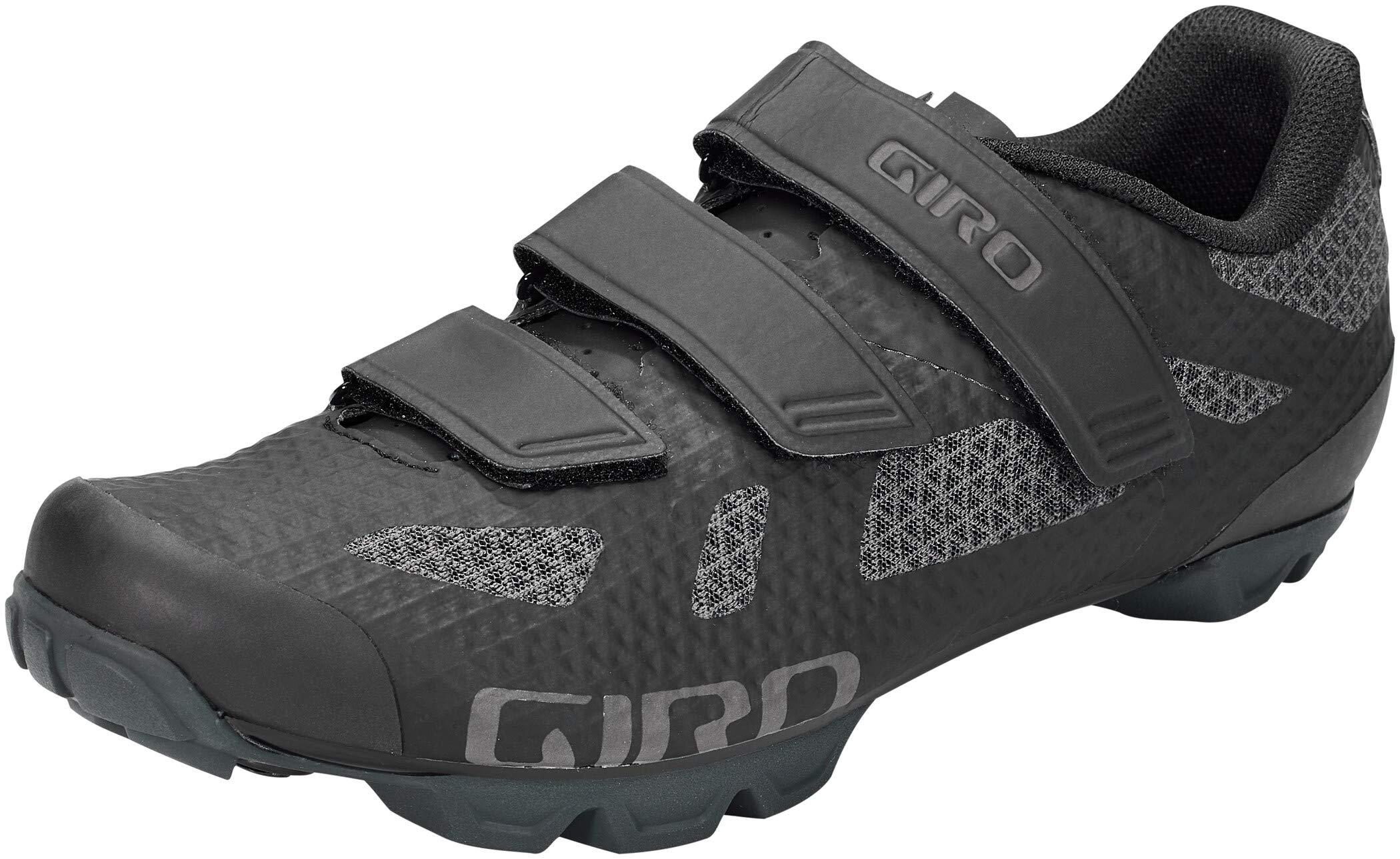
Giro Ranger

Giro

Giro Ranger

  • Closure Three straps
  • Outsole Rubber
  • Listed Weight 1.4 lb
  • Cleat Compatibility 2-bolt mountain
Check Price on Amazon

A cheap, sure-footed two-bolt shoe for new mountain bikers and gravel dabblers.

The Ranger is the cheapest way into a proper two-bolt mountain shoe here, and it does not feel like a toy. It has a one-piece upper, three straps, a nylon plate, and a rubber outsole with a bit of tread, so it is ready for gravel, singletrack, and the walk back to the car.

The three straps are easy to adjust, and the rubber outsole gives you traction when you unclip. The nylon plate is stiff enough for pedaling without making the shoe impossible to walk in. It is a simple build, and that simplicity is the point: the straps are easy to set with gloves on, and there is less hardware to think about.

We pick the Ranger for new mountain bikers and gravel riders who want a capable two-bolt shoe without spending much. The Fizik M6 is the step up if you want a BOA dial and a firmer sole, while the Shimano is the better choice for road and trainer use. The Ranger is the one we hand to a friend who is just getting started.

Bottom Line

We pick the Ranger as the budget mountain shoe for new riders who want two-bolt capability and a rubber outsole.

Check Latest Price

How We Tested Cycling Shoes

We started by scanning current models and filtering for pedal compatibility, available sizes, closure style, and price, then narrowed the list to 12 pairs we could ride regularly for seven months. Before the first ride, we checked stitching, strap anchors, cleat threads, and the shape of the sole at the toe and heel. We set each pair up with the correct cleats and noted how much fore-aft adjustment the mounting slots allowed.

Testers wore the shoes for road rides, gravel loops, indoor trainer sessions, and commutes, clipping in and out at stoplights and walking into coffee shops and offices. We paid attention to heel lift, toe-box pressure, hot spots after three hours, and whether the closure could be adjusted one-handed with gloves on. On the trainer, we stood and sprinted to judge sole stiffness, then walked across a parking lot to see how stiff shoes handled normal off-bike moments. We also checked how sizes ran for narrow, average, and wide feet, and whether Velcro straps stayed flat or curled at the ends.

Over the months, we watched for durability: scuffed toe caps, frayed straps, loosened cleat bolts, and uppers that softened or collapsed. We noted which shoes looked presentable with everyday clothes on a commute and which only made sense in cycling kit, then compared notes on value—what the pair delivered for the money versus the compromises we felt on longer rides. At the end, we ranked the 12 by comfort, build, compatibility, and how eagerly we reached for them.

How to Choose

Match the cleat to the pedal first

A cycling shoe is only useful if it clicks into your pedals. Peloton bikes use a Delta-style three-bolt cleat, while SPD is a two-bolt system; road bikes can use SPD-SL, Look, or another three-bolt standard. The shoe listing should name the system, not just say 'compatible.' If you ride both a Peloton and an SPD bike, a dual-compatible shoe like the VikoViren saves you from buying two pairs, but check the drilling before you order.

Fit and width matter more than stiffness

Cycling shoes should be snug through the heel and midfoot without pinching the toes. A stiff sole does not help if the shoe numbs your foot after 20 minutes. Wide feet should look for a roomier last or size up; the KESCOO runs large, while the Shimano and Giro Cadet run narrow. The closure matters too: a BOA dial is easier to fine-tune on the bike, while straps are simpler and cheaper to replace. Buy for the foot you have, not the stiffness number.

Decide how much walking you do

Road shoes prioritize a stiff sole and low weight; mountain shoes add a rubber outsole and a more walkable build. If your ride includes a coffee stop, a commute, or a hike-a-bike, the walkability of the TIEM or the rubber outsole of the Giro Ranger is worth more than a marginal stiffness gain. If you only clip in to train, the Giro Cadet's stiff sole makes more sense. The wrong choice is a race shoe for a spin class with a long walk to the locker room.

Check the closure and the wear parts

Straps, buckles, and cleat mounts are where budget shoes show their age. A BOA dial is precise, but a broken dial can sideline the shoe; a strap is less adjustable but easier to replace. Look for reinforced cleat holes and a closure that stays tight without maxing out the adjustment. The KESCOO is the cautionary example here: its roomy fit and low price are appealing, but the strap and buckle durability is why we place it below the Peloton shoe.

Frequently Asked Questions

Final Verdict

For most riders, the Shimano SH-RP101 is the shoe we point to first. It is SPD-compatible, comfortable enough for long trainer sessions, and simple enough to live with every day.

If you ride a Peloton and want the native fit, the Peloton shoe is the easier call; if you want a walkable indoor shoe, the TIEM Slipstream is worth the step up. Road riders who want a stiffer sole should look at the Giro Cadet, and mountain riders should start with the Fizik M6.