Outerwear & Layers

Best Cycling Jackets of 2026

A cycling jacket has to do two opposite things at once: hold off the wind on a cold descent and let the heat out ten minutes later when you're grinding up a climb. Most jackets pick one. The ones that block wind completely turn into a sauna the moment you work hard, and the ones that breathe let a chilly headwind straight through your chest. Getting both right — plus a fit that doesn't flap, ride up, or leave your wrists bare when you're stretched out on the drops — is what separates a jacket you reach for three times a week from one that stays on the hook.

Fit is where most of them fall down. Cycling gear is cut tighter than street clothes, arm length matters more than you'd expect once you're on the bars, and a jacket without rear pockets means digging under the hem for your phone at every stop. I've spent the past nine months riding in 12 jackets, from packable shells to insulated winter weights, and the gaps in warmth, wind resistance, and overall value showed up fast. The ones below earned their place.

Best Women's Thermal

Our Score 9.4/10
baleaf Women's Fleece Cycling Jacket

baleaf

baleaf Women's Fleece Cycling Jacket

  • Warmth Fleece lining
  • Sleeves Thumb holes
  • Storage Rear zip pocket and internal pockets
  • Water Resistance Water-resistant finish
Check Price on Amazon

Fleece-lined warmth and a flattering cut for women riding in the cold.

A lot of women's cycling jackets are a men's pattern taken in at the waist, and you feel it the moment you are on the drops. This baleaf is not one of those. It is shaped for a woman's shoulders and torso, and it is the warmest women's jacket in this group: a fleece-lined softshell that handles a winter commute without a second mid layer.

The warmth is the headline. The fleece lining is soft against a baselayer, the fabric stretches with you instead of bunching at the shoulders, and thumb holes keep the sleeves anchored and the wrists covered. In the 40s it is comfortable over a long-sleeve jersey; below freezing, add a proper base layer and it keeps up.

Storage is better than we expected for a jacket this sleek: a rear zip pocket takes a key, a card and a gel, and there are internal pockets for a phone. Two fit notes. Order up if you plan to layer, because it runs small and sits close through the chest, and the zip finishes high enough under the chin that an open collar is not really on the table.

Bottom Line

Our pick for women riding through winter: genuinely warm, shaped for a woman's torso, and cut to move with you on the bike.

Check Latest Price

Best Overall

Our Score 9.2/10
Przewalski Men's Winter Cycling Jacket

Przewalski

Przewalski Men's Winter Cycling Jacket

  • Warmth Thermal, windproof softshell
  • Storage Chest zip and rear pockets
  • Riding Cut Long back panel, cuff gauntlets
Check Price on Amazon

A cycling cut, real wind blocking, and enough warmth for most winter rides.

The detail that decided this one for us is the cut. The back panel runs long enough to stay put when you are bent over the bars, the cuff gauntlets close the gap between sleeve and glove, and the whole jacket is shaped around a riding position rather than a walk. That is what separates cycling kit from a running jacket with a cycling label on it, and it is why the Przewalski sits at the top of this list.

Warmth lands where most winter riding actually happens. It is a thermal, windproof softshell that stays comfortable into the high 30s with a jersey underneath, and above the mid-40s at hard effort it gets too warm, which is a job for the front zip rather than a reason to leave it at home. The windproof front does not turn the back into a plastic bag either; the rear panels let heat out on a climb.

Sizing is the thing to get right. This one runs small and the fit varies enough that your usual label is a poor guide, so order up if you plan to layer and measure against a jacket you already ride in. Get that sorted and the details land: a chest zip that swallows a phone, rear pockets exactly where your hand reaches, and enough room at the hem to sit over a jersey without bunching.

Bottom Line

This is the jacket we point most riders to: a proper cycling cut, steady wind blocking, and enough warmth for a whole winter of commuting.

Check Latest Price

Best Premium

Our Score 9.2/10
GOREWEAR C3 Infinium Thermo

GOREWEAR

GOREWEAR C3 Infinium Thermo

  • Fit Slim, cycling-specific cut
  • Weight 1.04 lb
  • Membrane GORE-TEX INFINIUM with WINDSTOPPER
  • Weather Protection Windproof, highly water-resistant
Check Price on Amazon

Race-fit windproof thermal for hard cold-weather rides, if you will pay for it.

GORE-TEX INFINIUM with WINDSTOPPER is what the money goes to, and it is a real membrane rather than a line on a hangtag. It blocks wind, sheds road spray and drizzle, and still lets sweat vapor out, which is the combination that keeps a hard winter ride from turning into a sauna.

What sold us is how much warmth comes out of so little material. The lining is fleece-like rather than fleece, closer to a wetsuit than a puffy jacket, and at 470 grams it layers like a jersey instead of a coat. The cut is unapologetically race-shaped: slim through the body, long in the sleeve, and at its best with a base layer and a mid layer underneath.

This is a riding garment rather than something you wear to the cafe afterward, and the slim fit runs at least a size tight, so plan on going up one. Set against the Przewalski it is a narrower tool: pricier, less forgiving of a casual pace, and noticeably better at holding a hard effort in genuinely cold air.

Bottom Line

For hard, cold training the windproofing and race fit are worth the premium, and we suggest sizing up.

Check Latest Price

Best for Rain

Our Score 9.2/10
Bikewa Waterproof Rain Jacket

Bikewa

Bikewa Waterproof Rain Jacket

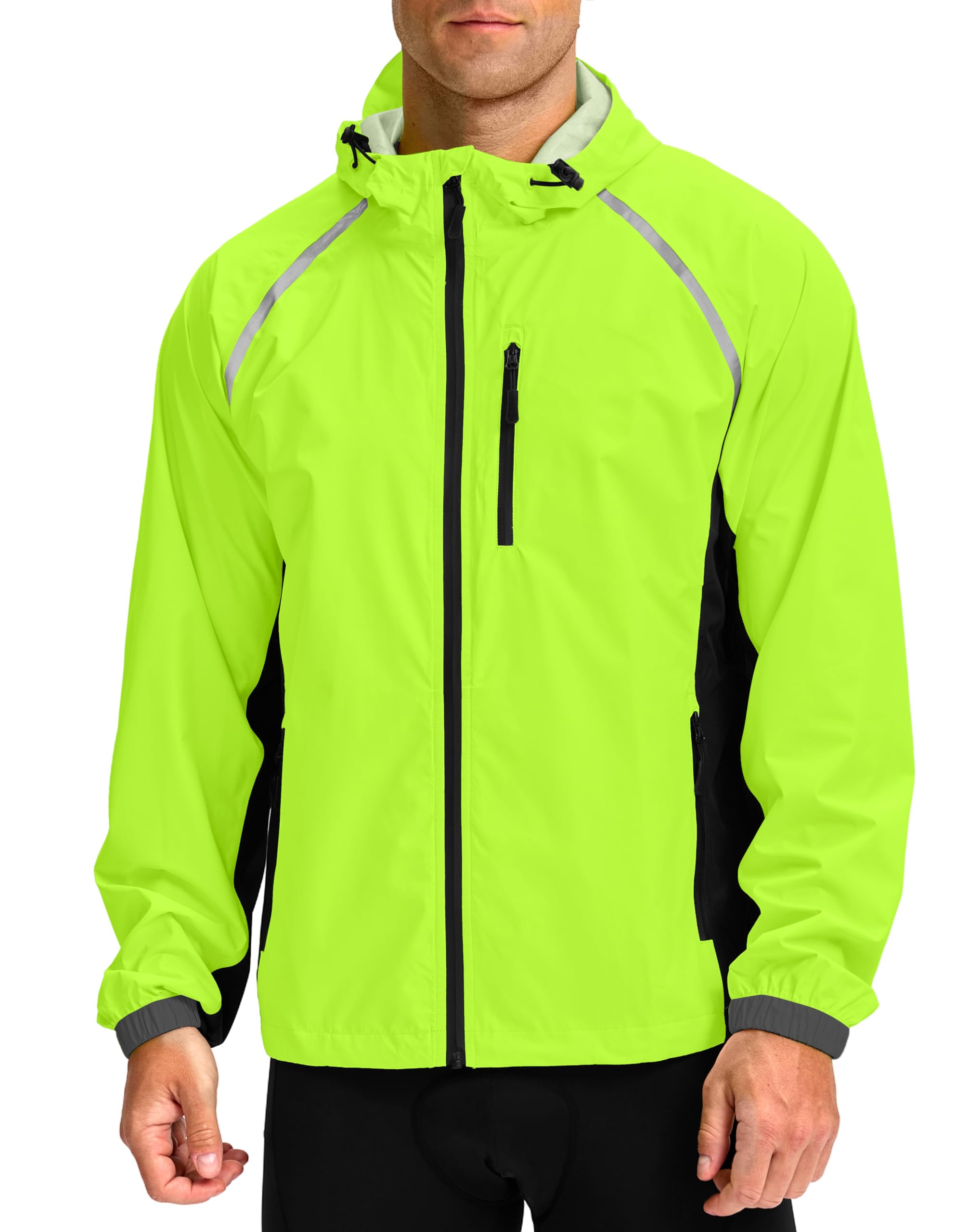
  • Pockets 3 zippered
  • Venting Underarm zips and back vents
  • Visibility Reflective front, back, and hood
  • Waterproofing DWR finish over laminated TPU membrane
Check Price on Amazon

A packable hooded shell that keeps steady rain out on the commute.

Rain changes the problem. On a wet ride you are cold from the inside, invisible in spray, and squinting into headlights, and a jacket has to answer all three at once. The Bikewa does: a laminated TPU membrane behind a durable water-repellent finish, reflective elements front, back and on the hood, and a fluorescent yellow that reads clearly in flat gray light.

The venting is what we noticed first. Underarm zips and a back vent let you seal the jacket against rain and still dump heat on a climb, which is the difference between finishing damp with sweat and finishing dry. The hood sits over a helmet rather than fighting it, and a rubberized band around the hem keeps the jacket from riding up when you are tucked.

What you give up is softness. The fabric crinkles when you move and the lining feels tacky against bare arms, which is what a genuine waterproof membrane feels like at this end of the market. Wear a long-sleeve base layer, keep it for the rides where staying dry matters more than feeling plush, and it does its job without complaint.

Bottom Line

The jacket we reach for when the forecast turns: properly waterproof, well vented, and bright enough to be seen through spray.

Check Latest Price

Best For Reflective cold rides

Our Score 9.2/10
baleaf Men's Softshell Cycling Jacket

baleaf

baleaf Men's Softshell Cycling Jacket

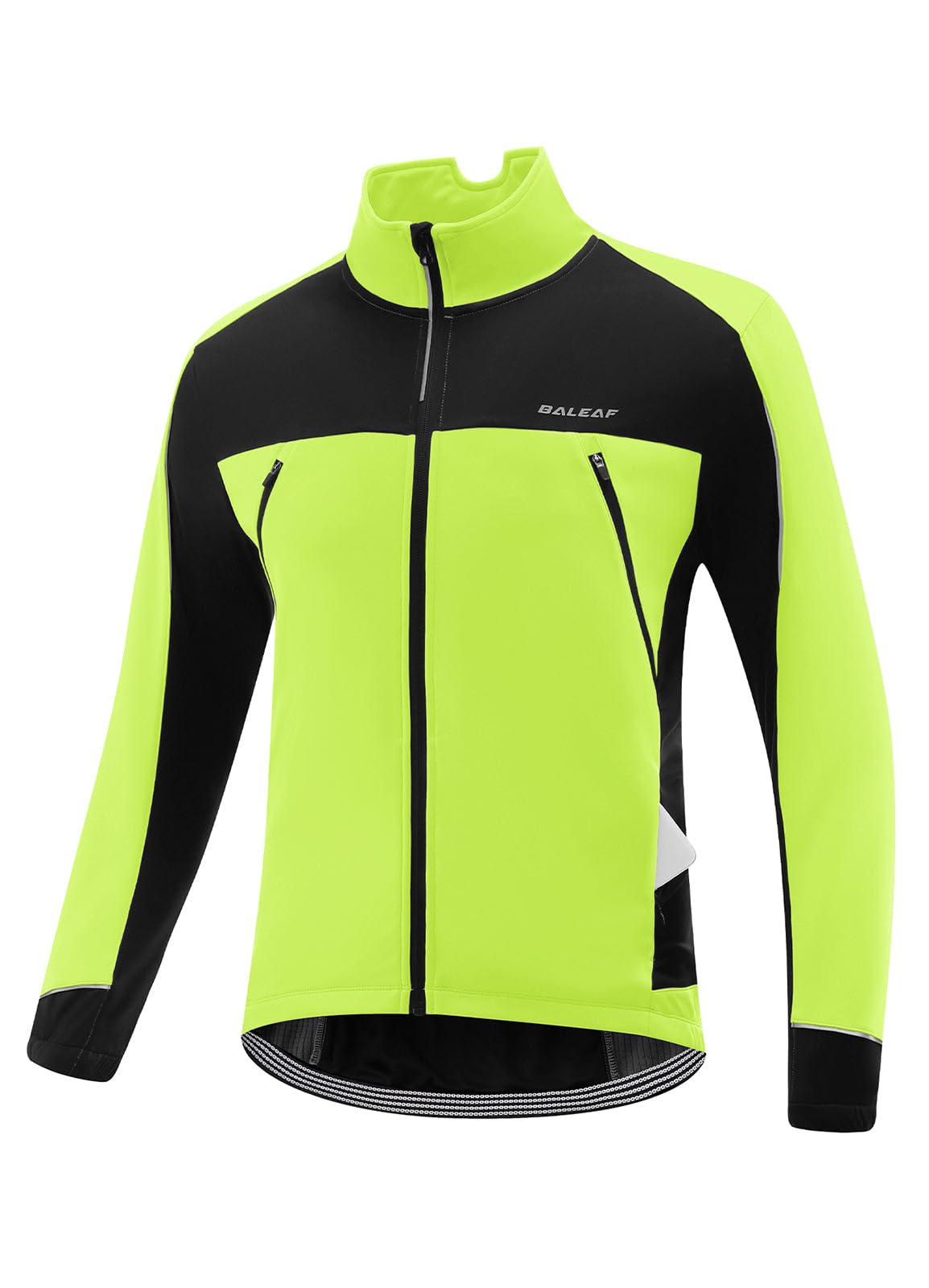
  • Collar Tall collar
  • Warmth Thermal softshell
  • Storage Rear pockets
  • Visibility Reflective strips
Check Price on Amazon

Reflective detailing is usually an afterthought, a couple of patches on the back and a promise. On this baleaf the trim runs where drivers actually see you, and the tall collar gives you somewhere to burrow on a cold start. It is the most visible jacket in this group that is not fluorescent yellow.

Warmth is honest rather than dramatic. With a thermal jersey underneath it is comfortable into the low 40s and happiest in the 40-to-50 band where a lot of winter riding actually happens, and it does not pretend to have the insulation for a hard freeze.

Fit is friendly to layering. There is room for a thermal jersey without the jacket turning into a sail, the elastic cuffs stay put, and the neck opening is wide enough that pulling it on over a jersey is not a wrestling match.

What we kept noticing is how little there is to think about. The rear pockets sit where you reach for them, the reflective panels catch headlights without turning the jacket into a highlighter, and the whole thing layers without fuss. Set against the Przewalski it is the softer, more visible jacket, and it is the one that ends up on the commuter bike's hook most weeks.

Bottom Line

Our pick when visibility matters most: reflective where drivers look, warm into the low 40s, and comfortable over a jersey.

Check Latest Price

Best Budget

Our Score 9.0/10
INBIKE Men's Fleece Softshell

INBIKE

INBIKE Men's Fleece Softshell

  • Collar High collar
  • Warmth Fleece-lined thermal softshell
  • Weight Lightweight, low bulk
  • Weather Protection Windproof, water-resistant
Check Price on Amazon

The least expensive jacket here, and warm with the right layers.

The INBIKE is the least expensive jacket here, and nothing about pulling it on feels like a compromise. The shell is thin, the fleece lining is soft, and the high collar closes the gap at the neck where cold air gets in.

Wind is where it punches above its price. The front blocks gusting air well enough for a cold morning with a base layer underneath, and the fabric does not billow at speed the way a loose shell does. It is light enough to forget you are wearing it, which matters more on a climb than it sounds.

Sleeve length is the inconsistent part, since some jackets come up generous at the wrist and others short, so try it over a long-sleeve jersey before you commit. Otherwise the money went to the right places: wind blocking, warmth, and a cut that stays out of the way. The waist drawcord cinches it down over a jersey, which is more adjustment than we expected at this end of the range.

Bottom Line

We recommend it to anyone testing whether winter riding sticks: light, windproof, and cheap enough to scuff without wincing.

Check Latest Price

Best Lightweight Women's

Our Score 8.8/10
FitsT4 Women's Reflective Windbreaker

FitsT4

FitsT4 Women's Reflective Windbreaker

  • Type Unlined hooded windbreaker
  • Visibility Bright color with reflective graphics
  • Packability Packs into its own back pocket
Check Price on Amazon

Packs into its own pocket and stays visible on gray-morning rides.

This is not rainwear, and treating it as such is the quickest way to be disappointed. The FitsT4 is an unlined, hooded windbreaker, thin enough to vanish into a jersey pocket and built for mild mornings, blustery descents, and the ride home after the sun drops.

As that layer it earns its place. It stuffs into its own back pocket, so it comes off on the climb and goes back on for the descent without a stop, and the reflective graphics plus a genuinely bright yellow do real work on gray roads. The hood goes up over a helmet without a fight, which is not a given on a shell this light.

Fit is the thing to sort before you order. It is roomy in some places and close across the shoulders and bust in others, so go by the chest measurement rather than your usual size and size up if you are between two. Get that right and it is the jacket that lives in your pocket all spring.

Bottom Line

The layer we keep in a jersey pocket for mild, gray rides: packable, genuinely visible, and hooded for the descent.

Check Latest Price

Best For Casual cold rides

Our Score 8.8/10
ARSUXEO Winter Softshell

ARSUXEO

ARSUXEO Winter Softshell

  • Warmth Fleece-lined softshell
  • Storage Chest zip and single rear pocket
  • Weather Protection Windproof, sheds light rain
Check Price on Amazon

Before anything else, the sizing. This jacket runs small, and fit is the most divided thing about it, so if you are a large in most outerwear start with an extra large, and go up two if you want a mid layer underneath. The payoff is a softshell that fits close enough to ride in without flapping.

The warmth is what keeps it in rotation. A fleece lining under a windproof softshell carries you through a 30-to-40-degree ride with a jersey and a base layer, and the fabric stays flexible in the cold instead of stiffening up like a hard shell.

Protection holds up where it counts. Wind is blocked across the front and down the arms, light rain beads off for a while, and the chest zip takes a phone and a card without bulging in the way.

So why recommend it? Because it is warm, it is inexpensive, and the core job of keeping a rider comfortable in cold air gets done. It does not have the Przewalski's shaping or the GOREWEAR's race fit, but as a first winter jacket or a spare for the worst weeks, it earns its hook in the garage.

Bottom Line

A warm, windproof starter jacket for riders on a tight budget, and one that rewards checking the size chart first.

Check Latest Price

How We Tested the Best Cycling Jackets

We started by rounding up roughly 40 jackets — shells, softshells, and insulated winter versions — from brands we've ridden in before and a few we hadn't. We cut that list by looking at temperature rating, claimed waterproofing, whether the size range went past a men's XL or a women's 2X, and what the price actually bought you. Twelve made the cut and went into open rotation rather than a lab, because a jacket only shows its weaknesses once you're sweating into it.

Every jacket went into the same rotation: a 25-minute commute on cold mornings, weekend rides of 40 to 60 miles with a long climb in the middle, and a handful of wet, miserable days I wouldn't have ridden otherwise. On the descent after each climb I noted where the cold hit first — chest, shoulders, or forearms — since that's usually where wind resistance quietly fails.

For rain, I wore each one in a real drizzle and, when the weather refused to cooperate, ran the sleeves and shoulders under a faucet for two minutes and checked how much reached the baselayer. I loaded the pockets with a phone, keys, and two gels to see which ones sagged or bounced, then reached for them one-handed mid-ride. Sleeve length was measured against my arm and rechecked with gloves on, on the drops, to see whether the cuffs left a gap at the wrist. After every wash I looked at seams, zips, and whether the water-repellent finish had given up.

How to Choose

Start with the temperature, not the season

Winter means something different in Minneapolis and in San Diego, and a jacket built for one is a sweatbox in the other. Thermal softshells like the Przewalski and the ARSUXEO make real warmth from a fleece lining behind a windproof face, and they run out of usefulness somewhere in the mid-40s at hard effort. Unlined shells like the FitsT4 sit at the far other end: barely there on a mild morning and no protection at all in a freeze.

Most committed riders end up owning both ends of that range rather than one jacket that does everything. Buying for the cold you actually get is cheaper than buying twice.

Wind protection is what keeps you warm

A thin windproof jacket beats a thick fleece once you are moving, because moving air strips your body heat and still air does not. That is why the face fabric matters less than where the blocking sits: everything here stops wind across the chest, and the better designs leave the back and underarms more permeable so the heat you build on a climb has somewhere to go. Pit zips and back vents do the same job on demand.

A jacket that is windproof everywhere and breathable nowhere leaves you soaked from the inside by mile ten. If you run hot, prioritise venting over another layer of insulation.

Waterproof, water-resistant, and wishful thinking

These are not the same claim, and the gap between them is a wet ride home. A water-resistant finish sheds mist and road spray and gives up in steady rain, while a laminated membrane like the one in the Bikewa keeps water out for the length of a commute. If you ride in real rain, buy the membrane and accept the crinkle and the slightly tacky lining.

If your riding is drizzle and dry cold, a water-resistant thermal is warmer, quieter and far more comfortable next to the skin.

Fit on the bike is not fit in the shop

Standing in front of a mirror tells you almost nothing. A cycling jacket needs a back panel long enough to cover you bent over the bars, sleeves that reach your wrists in the drops, and a collar that closes without choking you. Put it on over the layers you will actually wear, then get on the bike.

Sizing is the other trap. Several of these jackets are cut small, so measure your chest and order up if you plan to layer; the label in your closet is a worse guide than the size chart on the page.

Visibility and what you carry

Reflectivity earns its place on gray mornings and after-work rides, and the best designs put it where drivers look: cuffs, back and hood. Storage splits along a fault line instead. Rear pockets are perfect on the bike and useless off it, and hand pockets are the reverse, so decide which version of the jacket you are buying.

If you want one jacket for riding and errands, take a relaxed cut with side pockets and a reflective hit. If it is for training only, rear pockets win every time.

Frequently Asked Questions

Final Verdict

The Przewalski is the jacket we recommend first. It is cut for the bike, it blocks wind where wind actually hits, and its warmth range covers most of what a winter throws at a rider.

Pick the GOREWEAR if your cold rides are hard efforts and you want a race fit that does not flap. Pick the Bikewa shell if rain is what keeps you off the bike. Women should start with the baleaf fleece, and order up.