Yoga & Mobility

Best Core Sliders of 2026

Two discs under your hands and feet turn a patch of floor into a core workout. The mechanism is friction: enough grip to hold a plank, little enough that your knees travel out and back without catching. Get the balance wrong and you're either stuck in place or skidding into the coffee table, so what a good set fixes isn't motivation — it's that dead spot in a bodyweight routine where you've run out of progressions. We put 16 sets through four months of planks, mountain climbers, and lunges to sort the ones worth owning.

Here's the thing nobody tells you first: your floor decides almost as much as the disc does. A slider that glides beautifully across carpet can grab and chatter on hardwood, and a rough edge can leave a mark you'll see every time you walk past. So check the surface you'll actually use, then think about how the thing feels under your palms and knees by the tenth rep. We kept both in mind for every set below, and there's a pair here for whatever floor you're working with.

Best for Keeping Feet Planted

Our Score 9.4/10
BODi Strength Slides

BODi

BODi Strength Slides

  • Size Extra-wide
  • Surfaces Hardwood, carpet, concrete
  • In The Box 2 slides and 2 booties
Check Price on Amazon

Dished, extra-wide slides that keep bare feet centered, plus booties for hardwood floors.

Every other pair here is a flat circle. The BODi slides are dished, with rims that curl up around your foot, and the set arrives with two cloth booties that slip over the disc for hardwood work.

That shape does one thing better than anything else in this guide: it keeps a bare foot centered. Where a flat disc lets a heel creep off the back edge on a reverse lunge, the raised rim gives you something to press against, and the extra width means both sets of toes fit on one slide. The booties matter on wood and tile, where they are meant to keep your soles from grabbing.

They are the most expensive pair here, and we still reach for them when grip is the whole point: barefoot work, lunges in every direction, sweaty sessions where a flat disc turns into a skating rink. The limits are specific and worth checking against your room. BODi lists hardwood, carpet, and concrete, and the pair does not work on Berber carpet or rubber gym flooring.

Bottom Line

We recommend these for anyone whose feet keep sliding off flat discs: the dished rim, wider face, and booties address the problem that sends people shopping twice.

Check Latest Price

Best For Travel kit

Our Score 9.2/10
Mr. Pen Core Sliders

Mr.

Mr. Pen Core Sliders

  • Diameter 7 in
  • Material ABS plastic
  • Item Weight 1 oz
Check Price on Amazon

Ounce for ounce, this is the easiest pair here to live with. Each disc weighs about an ounce, they measure 7 inches across, and they stack flat enough to disappear into a laptop bag or a desk drawer. We keep a set in a gym bag for exactly that reason: they are the pair that is actually with you when a workout breaks out.

ABS plastic on one side, foam on the other, in a bright blue that is easy to spot. The trade-off is size: as a hand pad they are on the small side, and bigger palms will feel the edges. For a pair that travels, that is a reasonable compromise.

Bottom Line

The pair we keep in a bag: light enough to carry everywhere, cheap enough to own two sets, and smooth on flat floors.

Check Latest Price

Best Overall

Our Score 9.0/10
Synergee Core Sliders

Synergee

Synergee Core Sliders

  • Diameter 7 in
  • Material PVC
  • Warranty Lifetime
  • In The Box 2 sliders and a printed exercise manual
Check Price on Amazon

Our default pair: dual-sided, sold with a workout booklet, and priced below most here.

If you have never owned a pair of sliders, these are the ones to learn on. Two 7-inch PVC discs, one slick plastic face for carpet and one foam face for hardwood, a color-printed exercise booklet, and a lifetime warranty that most of the pairs here do not offer.

That combination is why we recommend them as the default. Flip the plastic side down on a low-pile rug and the disc runs; turn the foam side down on hardwood and it tracks instead of skating out from under you. In a category where the discs all look alike, the dual-sided build, the booklet, and the warranty are the things that actually change how your first month goes.

Seven inches is a hand or a foot, not both, and on plush carpet or with sweaty bare feet the plastic side can drag and let a heel drift off the back edge. Socks help. So does driving through the middle of the disc rather than the toes. If slipping is already the reason you stopped using sliders, the BODi pair below is the more direct fix.

One gap worth naming: Synergee does not publish a weight rating. If you are a heavier user, or you plan to stack a lot of load onto one disc, the Gaiam pair states a 400-pound limit and is the safer buy. Everyone else can start here and stop shopping.

Bottom Line

Our default pick: a dual-sided pair that works on carpet and hardwood, ships with a workout booklet, and asks very little of your wallet.

Check Latest Price

Best for Heavier Users

Our Score 9.0/10
Gaiam Core Sliding Discs

Gaiam

Gaiam Core Sliding Discs

  • Material PVC and EVA foam
  • Disc Weight 4.96 oz
  • Weight Limit 400 lb
Check Price on Amazon

Rated to 400 pounds, with foam that behaves on hardwood and a slim, packable profile.

Four hundred pounds is the number that makes the Gaiam discs worth a look. It is the highest stated limit of any pair here, and it sits on a disc that weighs under five ounces.

The build is PVC with an EVA foam face. Foam side down for hardwood, tile, and laminate; plastic side down for carpet. They are light enough to toss in a tote, they pack flat, and unlike the bootie-and-slide sets there is nothing separate to lose.

Grip is where these need a little planning. On smooth wood they run well; on low-pile rug the foam face can grab and turn a lunge into a shove. Match the face to the floor and they behave. Leave the foam down on carpet and you will conclude they are broken when they are not.

For a heavier user, or for one pair covering a hardwood living room and a tiled kitchen, this is the version we point to. The rating is genuine headroom rather than marketing, the slim profile disappears into a drawer between sessions, and the price sits in the middle of this group.

Bottom Line

We point heavier users to these: the highest weight rating in this group, foam that behaves on hardwood, and a slim disc that stores anywhere.

Check Latest Price

Best Large Surface for Carpet

Our Score 9.0/10
SKLZ Slidez

SKLZ

SKLZ Slidez

  • Material Plastic
  • Connection Integrated clips join the pair
  • Weight Limit 330 lb
  • Item Dimensions 1.1 x 14.33 x 10.79 in
Check Price on Amazon

Big padded pads that clip together for two-handed moves on low-pile carpet.

The clips are the reason to look at the SKLZ Slidez. Snap the two pads together and they become one wide platform for both hands or both feet, which opens up push-up and plank variations the round discs cannot do.

They are also the biggest footprint here, with an ergonomic tread on top and a shape built for omnidirectional movement, so lateral and rotational work feels natural. Size is the point: your hands do not creep toward the edges halfway through a rep.

Carpet is where they belong. The foam top is comfortable under a knee or an elbow, but it is not the face you want dragging across finished hardwood, so keep these on rugs and low-pile carpet and save the wood-floor work for a pair with a proper hard-floor side.

For a carpeted home gym and a routine built on planks, mountain climbers, and slow lateral work, these are the most capable pads in this group, and the most expensive. What we found is that the size changes the workout, not just the comfort: there is room to load both hands and really slow the tempo down.

Bottom Line

Our choice for a carpeted home gym: big padded pads that clip into one wide platform for two-handed work, priced like the specialty tool they are.

Check Latest Price

Best For Hardwood and tile

Our Score 9.0/10
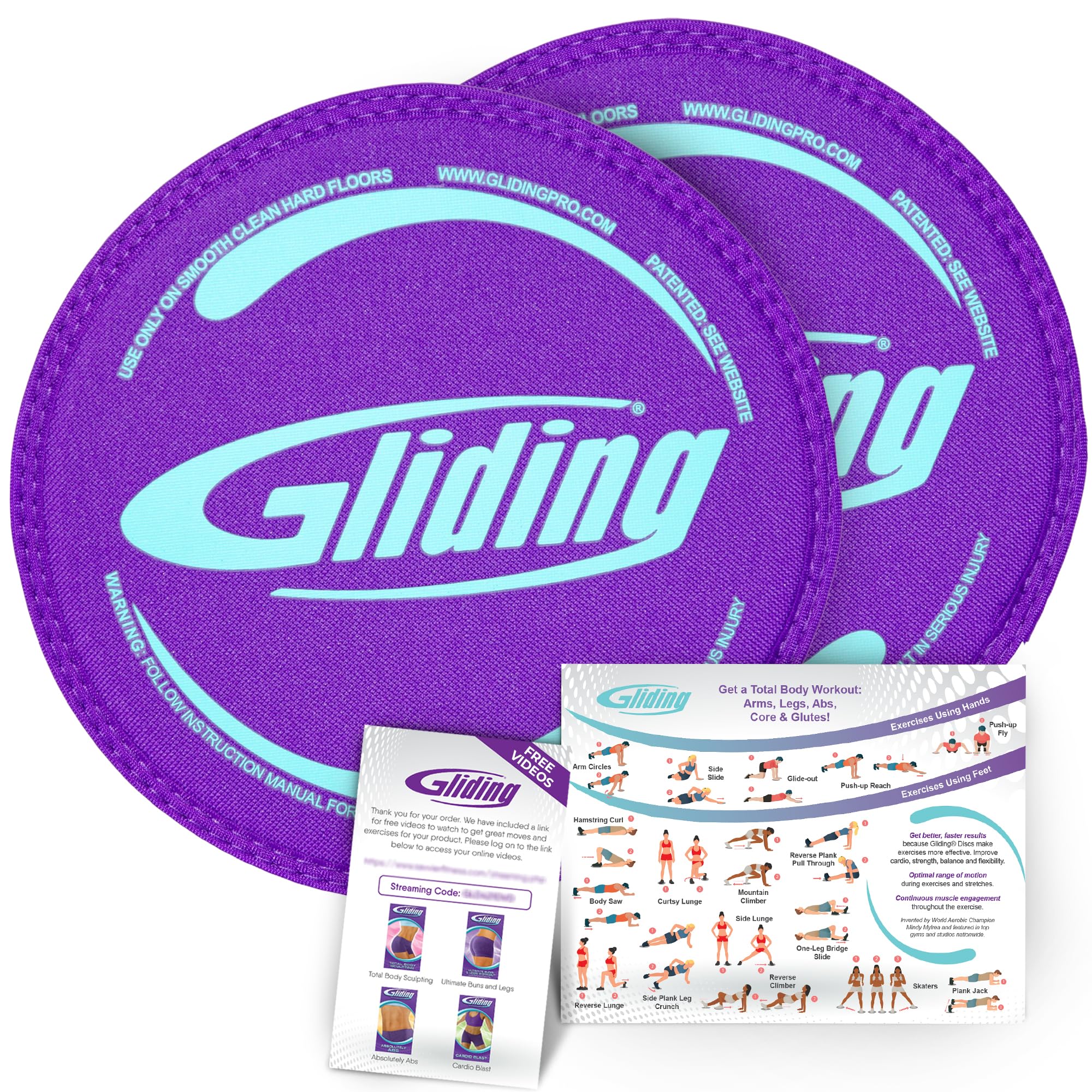
Gliding 9-Inch Sliders

Gliding

Gliding 9-Inch Sliders

  • Diameter 9 in
  • Material Nylon
  • Surfaces Hardwood and tile
  • Item Weight 5 oz
Check Price on Amazon

The first thing to know is that this is a hard-floor disc: a nylon face, 9 inches across, sold for hardwood and tile rather than as a dual-sided pair.

Nine inches is a lot of disc. It covers a whole foot with room to spare and gives both hands somewhere to sit during a sliding push-up, and on smooth floors that extra contact area is what keeps the movement from catching. You also get access to four streaming workouts, a reasonable nudge if you are starting from nothing, though the discs are the reason to buy.

For a wood-only space this is the best big disc in the group, and the one we point to when the living room floor is the gym. Nylon on tile and laminate moves with very little effort, which is what you want under a foot that is already carrying your weight.

Bottom Line

We recommend these only for hard floors, where the 9-inch nylon disc offers the biggest contact patch in this group.

Check Latest Price

Best for Working Out in Shoes

Our Score 8.8/10
Elite Sportz Core Sliders

Elite

Elite Sportz Core Sliders

  • Diameter 7.09 in
  • Material Plastic
  • Item Weight 6.4 oz
  • Weight Limit 300 lb
Check Price on Amazon

A grippy face that holds a sneaker sole, so shoes stay on through the circuit.

Most sliders assume bare feet or socks. The Elite Sportz pair is the one that behaves with a sneaker on: the dual-surface design holds a shoe sole instead of letting it skate, and the 7.09-inch disc is wide enough for larger shoe sizes, which is more than some pairs here manage.

That makes them our pick for anyone who trains in shoes, the sort of circuit where you are not stopping to strip socks off between moves. The 300-pound rating covers most home lifters, each disc weighs a little over six ounces, and they work on hardwood, carpet, and padded gym mats.

The one thing they will not do is swallow a whole foot. At just over 7 inches these are hand-and-foot discs, not platforms, so two feet on a single slider is not happening. For a carpeted living room, a mat, or a gym floor, that is a fair trade for a disc that grips a shoe.

Bottom Line

This is our pick for anyone who trains in sneakers: a face that holds a shoe sole and a 300-pound rating, at roughly what the plainest pairs here cost.

Check Latest Price

Best Budget Kit

Our Score 8.8/10
Iron Core Fitness Sliders

Iron Core Fitness

Iron Core Fitness Sliders

  • Diameter 6.9 in
  • In The Box Illustrated exercise guide
  • Item Weight 5.29 oz
  • Weight Limit 300 lb
Check Price on Amazon

A light, cheap pair sold with an illustrated guide that maps out your first routines.

The exercise guide is what separates the Iron Core pair from the other budget discs. It is a printed booklet with step-by-step photos, and for the first week, when you do not yet know what to do with your feet, we think that is worth more than another inch of diameter.

The discs are 6.9 inches across, plastic on one side and foam on the other, rated to 300 pounds. They are light, the aqua color is easy to find at the bottom of a bag, and the pair covers carpet and hardwood both.

The soft side is the one to watch. It glides on smooth hardwood but can catch on anything with texture, and the plastic side is only as good as the rug underneath it. On a flat, even floor with the right face down, they do most of what the pricier pairs do; the difference is in the finish, not the function.

Bottom Line

We like this set for a first routine: a cheap, light pair sold with an illustrated guide that tells you what to do on day one.

Check Latest Price

How We Tested Core Sliders on Carpet, Hardwood, and Tile

We started with a list of more than 40 sets and narrowed it by reading through reviews for the complaints that actually matter — discs that chewed up hardwood, foam pads that peeled away after a few washes, and sets too small for anyone with a men's shoe size over 10. That left 16 sets spanning hard plastic, foam-backed plastic, and fabric-covered discs across a range of diameters, which we used roughly four times a week for four months.

Testing happened where sliders really live: a living room rug, a strip of old hardwood, a finished basement carpet, and a tile bathroom floor just wide enough for one plank. Every set ran the same circuit — knee tucks, mountain climbers, reverse lunges, and pike holds — barefoot, in socks, and in sneakers, since socks on a hard disc is how people end up on the floor. We watched for discs that spun out from under a foot mid-rep, caught on carpet pile, or left a scuff when dragged across the hardwood.

To check grip, we did planks with deliberately sweaty palms and noted whether the disc shifted or stayed put. Cushioning got judged by how a kneeling position felt on rep twenty versus rep two. After four months we inspected each set for scored surfaces, chipped edges, and foam that had begun to lift, and counted how many were still flat and round. Ease of use came down to small things, like switching from hands to feet without chasing a disc across the room. Value was the last filter, and a few of the cheapest sets performed identically to ones that cost several times more.

How to Choose

Start With the Floor, Not the Brand

Every pair here is dual-sided, and the two sides are not interchangeable. Plastic or nylon goes down on carpet; foam or fabric goes down on hardwood, tile, and laminate. Get that right and a cheap disc feels fine. Get it wrong and an expensive one feels broken.

The floor matters as much as the face. Low-pile rug and firm carpet are where plastic slides; plush pile grabs almost everything, and rubber gym flooring defeats every pair in this guide. Press a palm into your carpet before you order. If your hand sinks in, expect to work harder and lean toward a pair with more surface area.

One Foot, Two Feet, or a Hand

The standard disc is 7 inches, which is one foot or one hand and not much more. Bigger feet, and anyone who wants both hands planted on a single disc for push-ups, should look at the 9-inch Gliding discs or the clip-together SKLZ pads. The disc has to hold the part of you that is moving; if your heel hangs off the back edge, every rep turns into a balance drill.

The Grip Problem Nobody Mentions

Glide and grip are two different things, and the second one is what ends most slider sessions. A flat disc with a slick top lets a sweaty foot creep off mid-lunge; a dished rim, a wider face, or a bootie keeps you centered. If you train barefoot, pay for the shape. The BODi slides exist for exactly this reason, and they are the pair we recommend to anyone who has already given up on sliders once.

Weight Ratings, Wear, and Extras

Stated limits in this group run from 300 to 400 pounds. If you are near or over 300, buy the Gaiam discs and stop deliberating. Expect the foam or fabric face to be the first thing to go, so store the discs face-up rather than tossing them loose in a bag.

Extras are worth what they cost you. A printed exercise booklet, as with the Synergee and Iron Core pairs, helps more in week one than a streaming video library you open once. Booties are the exception: on hardwood they solve a real problem.

Frequently Asked Questions

Final Verdict

Start with the Synergee discs. They glide on both surfaces, come with a booklet, and ask so little of your budget that there is no reason to overthink a first pair.

If your feet keep sliding off flat discs, the BODi slides and their dished rim are the upgrade worth paying for. Heavier users should take the Gaiam pair and its 400-pound rating, and anyone whose training space has no carpet in it should buy the 9-inch Gliding discs and skip the rest.