Strength & Weights

Best Compact Functional Trainers of 2026

A functional trainer puts a cable crossover in the corner of a room instead of the middle of a gym — the same flies, rows, and presses, in a footprint that fits against a bedroom wall. The hard part is that shrinking the frame is exactly where the good stuff tends to get lost: pulleys that jerk instead of glide, a range of motion that stops short at the top, a base that skids across the floor the moment you pull something heavy. That's the gamble with this whole category.

I've kept a cable station in my garage for years, and the trainers that stay in use are never the ones with the longest attachment list — they're the ones that adjust in a second, stay planted under load, and feel smooth enough that you forget you're pulling on a cable. We've spent the past eight months assembling, loading, and training on seven compact trainers in garages, spare bedrooms, and one very patient living room. The picks below are the ones worth the floor space.

Best Overall

Our Score 9.2/10
Inspire Fitness FTX

Inspire Fitness

Inspire Fitness FTX

  • Footprint 54"D x 40"W x 82"H
  • Weight Stacks Two 165 lb stacks
  • Machine Weight 544 lb
  • Included Attachments Rope, two D handles, curl bar, dip belt
Check Price on Amazon

Two 165-pound stacks and a smooth glide in a 40-inch-wide frame.

Forty inches of width is the whole ask. The FTX puts two independent 165-pound stacks inside that, plus a full-height cable run, and at 54 inches deep and 82 inches tall it slides into the end of a garage bay or the corner of a spare room without taking over the middle of the floor. Most machines with two real stacks want a wall to themselves; this one does not.

What convinced us is how little it interferes with the work. The cable runs are quiet and even, and the pulleys track without the shimmy that makes light cable work feel sloppy, which is the difference between a machine you warm up on and one you walk past. The frame stays planted with both stacks loaded, and assembly is manageable rather than a project that needs a professional.

The accessories are a real kit rather than filler: a tricep rope, two deluxe D handles, a dual-hook curl bar, a chin/dip belt, plus a shelf for a phone and hooks that keep the handles off the floor. The ceiling is 165 pounds a side, though, and that is where a strong lifter will feel the limit on rows and pressing. If your training needs more resistance, the Body-Solid PFT100 carries heavier stacks.

Bottom Line

The best balance of footprint and capability here: a genuine two-stack trainer that fits a corner, with a glide and a build that earn the premium.

Check Latest Price

Best for Heavy Lifting

Our Score 9.2/10
Body-Solid PFT100

Body-Solid

Body-Solid PFT100

  • Footprint 42.3"D x 62.6"W x 83"H
  • Weight Stacks Two independent stacks, up to 210 lb
  • Frame Warranty 10 years
  • Machine Weight 476 lb
Check Price on Amazon

Independent 210-pound stacks for isolateral work, backed for 10 years.

Two stacks that work completely independently is a different proposition from one cable split by a pulley. On the PFT100 each side carries its own 210 pounds, so a single-arm row gets the full load without the other handle drifting, and a crossover does not depend on where the second stack happens to be sitting.

It is also the widest machine here at 62.6 inches, which sounds like the wrong answer to a compact brief, but it is only 42.3 inches deep. That means it lines up along a wall instead of jutting into the room. In a long garage bay that trade is a good one; in a box room it is not, and no amount of clever pulley design fixes it.

Where it earns its place is under load. The frame carries a 10-year warranty, the machine weighs 476 pounds, and the glide stays quiet and free of wiggle with both stacks near the top. We came away thinking of it as the pick for someone whose training is built on heavy cable work rather than on variety.

Two practical notes. Threading the pulleys is the fiddly stretch of the build, so give it the daylight rather than the last half hour of an evening. And the box contains the machine only, so budget for a rope and a pair of handles you actually like.

Bottom Line

Choose it when the weight matters most: two independent 210-pound stacks and a frame that stays quiet under them, at the cost of a long wall.

Check Latest Price

Best Space-Saving

Our Score 9.0/10
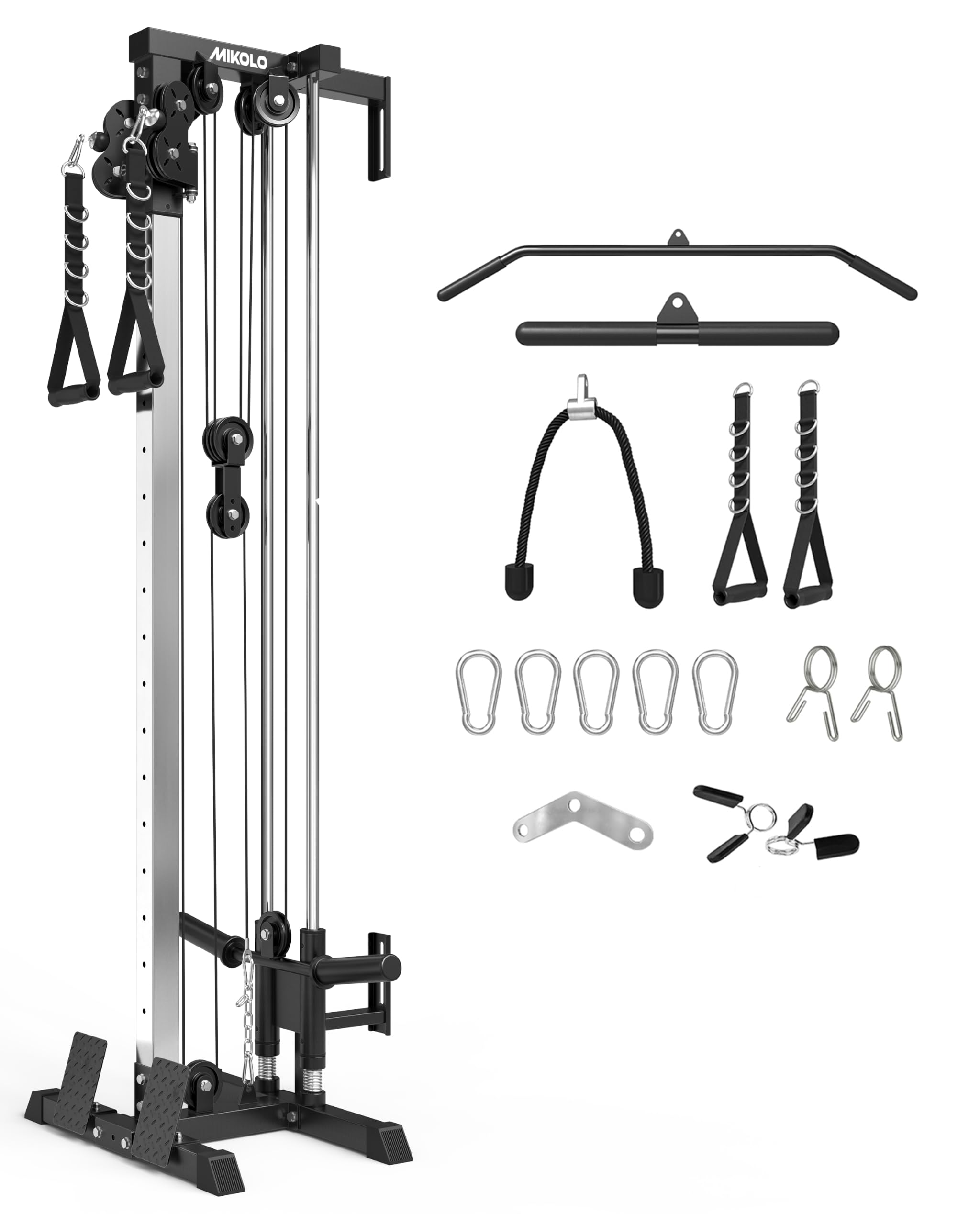
Mikolo Wall Mount Station

Mikolo

Mikolo Wall Mount Station

  • Footprint 26.9"D x 25.6"W x 82"H
  • Resistance Plate loaded, up to 400 lb
  • Cable Rating 2,200 lb tensile strength
  • Pulley Positions 19 heights, dual adjustable
Check Price on Amazon

Bolts to a wall for a 27-inch-deep footprint, with 19 pulley heights.

Bolting a trainer to a wall changes what it costs you in floor space. This Mikolo takes 26.9 inches of depth and 25.6 of width, leaves no floor frame to walk around, and does not rock when you pull hard. In exchange your wall becomes part of the machine, and you stop thinking of the room as a gym.

We have come to think the details that matter daily are the boring ones, and this one gets them right: 19 height positions on each side, a 2,200-pound tensile cable, and plate pegs angled at 10 degrees so iron does not slide off mid-set. A lat bar, a cable bar and a tricep rope come in the box, and the assembly video handles the cable routing well enough to follow without pausing every thirty seconds.

Two things to settle first. It is plate-loaded, rated to 400 pounds of plates you supply, so the iron is an extra purchase and a storage decision. And the pulley wheels are plastic: they run fine, better once the cables have a little silicone on them, but they do not have the weighty feel of a stack. A cable fly also feels cramped, since the two pulleys sit close together on a 25.6-inch frame.

Bottom Line

If floor space is the hard limit, bolt this up: dual pulleys, 19 positions and a solid feel for the smallest footprint of any dual-pulley pick here.

Check Latest Price

Best All-In-One

Our Score 9.0/10
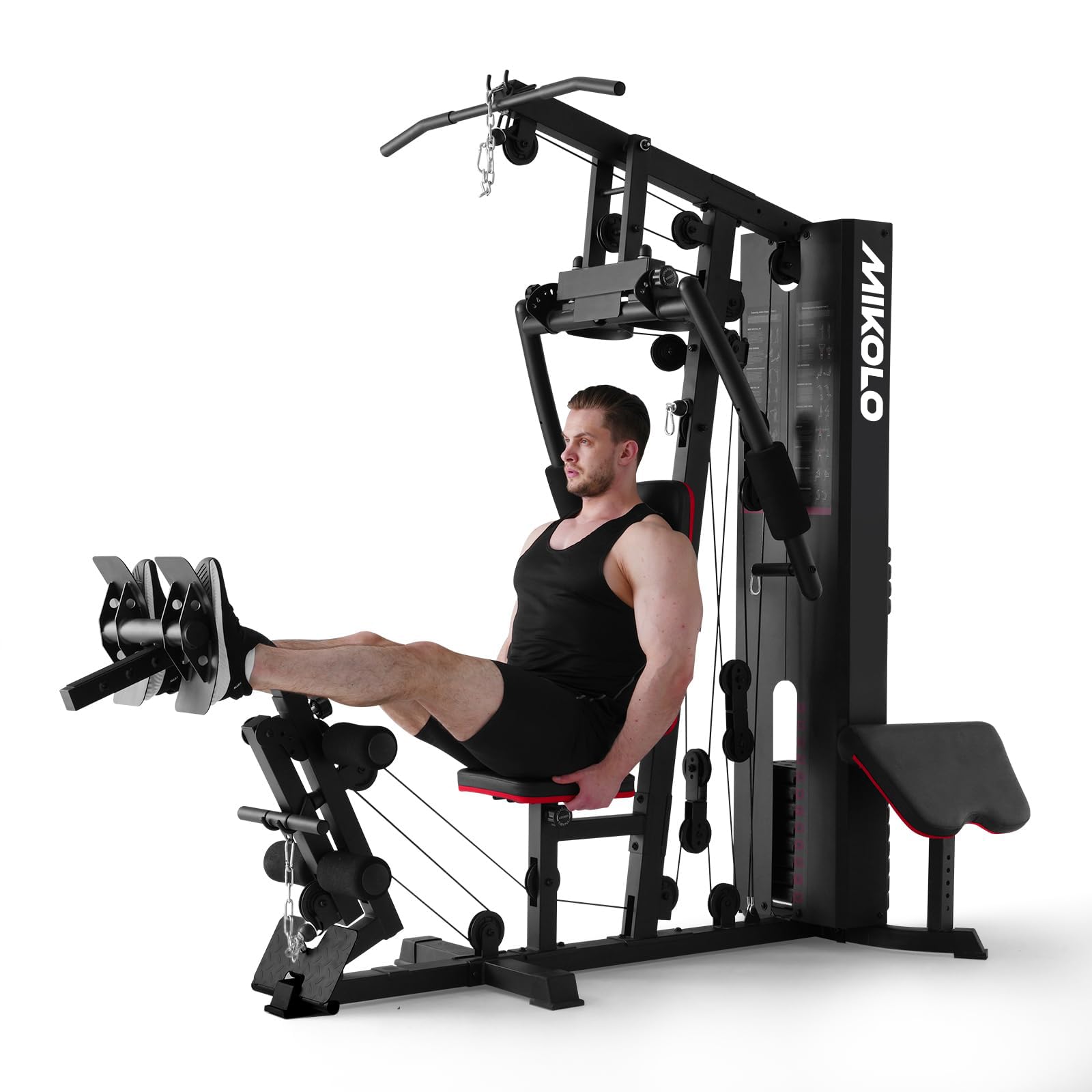
Mikolo HGS Pro Home Gym

Mikolo

Mikolo HGS Pro Home Gym

  • Footprint 75"D x 36.3"W x 80"H
  • Weight Stack 154 lb, 12 levels
  • Frame Warranty Lifetime on frame
  • Exercise Stations 10-in-1, includes leg press
Check Price on Amazon

Ten stations, including a leg press and preacher curl, in 36 inches.

The HGS Pro is what you buy when cables are only part of the plan. Behind the pulleys sit a leg press, a preacher curl pad, a chest press and a leg extension, so one 36.3-inch-wide frame covers 10 movements that would otherwise mean three machines and a lot more floor.

The stack is 154 pounds across 12 levels, and the cables run on a high, mid and low pulley system, so cable work is a real part of the machine rather than an add-on. The attachment set is generous too: two D handles, a short cable bar, a lat pulldown bar, a tricep rope and a chain.

Assembly is the honest cost. It is a two-hour build at best, and the directions are uneven, so watch the assembly video first and sort the hardware into piles before you start. The seat does not slide fore and aft, and the middle pulley's travel runs short, so on some movements you adjust yourself to the machine rather than the other way round.

Seventy-five inches of depth is the real price of all those stations. This wants a corner of its own, and in a room where the FTX fits along one wall, the Mikolo eats a chunk of floor. We think that is a fair trade for someone starting a gym from nothing, because it stands in for the leg press and preacher bench you would otherwise buy separately.

Bottom Line

For a first home gym with room for one machine, this replaces a leg press, a preacher bench and a cable station in 36 inches of width.

Check Latest Price

Best with a Pull-Up Bar

Our Score 8.8/10
Valor Fitness BD-61

Valor Fitness

Valor Fitness BD-61

  • Footprint 56"D x 50"W x 81"H
  • Resistance Plate loaded, up to 200 lb
  • Machine Weight 174 lb
  • Pulley Positions 17 heights
Check Price on Amazon

Plate-loaded cables, 17 positions, and a pull-up bar over the frame.

The pull-up bar is what sells this one for us. Cables cover pulling from every angle, but nothing replaces a set of chin-ups at the end of a session, and the BD-61 is the only machine here that gives you a bar along with 17 pulley heights.

It is plate-loaded, up to 200 pounds, with sleeves for both one- and two-inch plates, so resistance is whatever iron you already own plus whatever you add. Bare, the frame weighs 174 pounds, light enough that the included floor-mounting hardware is worth using rather than leaving in the box.

Budget an afternoon for the cables. Threading them through the double guide track is the step that stops builds, and the routing diagram is the weakest thing about the machine. If you have done one before it is an afternoon; if you have not, watch a routing video first and lay the parts out in order.

Everything after that behaves well: the glide is even, the 17 positions cover the range most people use, and the curl/row bar and strap handles mean you can train the day you finish assembly.

Bottom Line

The one to get if you want a pull-up bar and honest cable work without buying a stack, as long as you plan a slow afternoon for the cables.

Check Latest Price

Best For Single-stack training

Our Score 8.8/10
Body-Solid BFFT10R

Body-Solid

Body-Solid BFFT10R

  • Pulleys 180° swivel
  • Weight Stack 190 lb
  • Frame Warranty 3 years in-home
  • Machine Weight 330 lb
Check Price on Amazon

Pulleys that swivel 180 degrees are the detail that separates this Body-Solid from a plain crossover. Rotating the housing lets you start a press or a fly at the angle your shoulder wants rather than the one the frame allows, which is worth having if a fixed cable has ever pulled you out of position.

The stack is 190 pounds, the second-heaviest single stack here, and the frame is covered for three years in-home, longer than most in this group. At 330 pounds the machine sits at the lighter end of the freestanding picks, which means two people can shift it when the room gets rearranged.

What we could not get past is cable travel. The pull runs short, and on long-arc movements such as lat pulldowns a tall lifter shortens the range or shifts position to finish the rep. Pressing, rowing and flys are fine, and the textured loading pins and rounded stack pulleys are small things you notice every session.

The manual is a parts list and an exploded diagram rather than written steps, so sorting the hardware into trays before you start saves a chunk of the build.

Bottom Line

A steady single-stack trainer for pressing, rowing and flys, though long-arc cable movements will feel cramped.

Check Latest Price

Best For Small rooms

Our Score 8.6/10
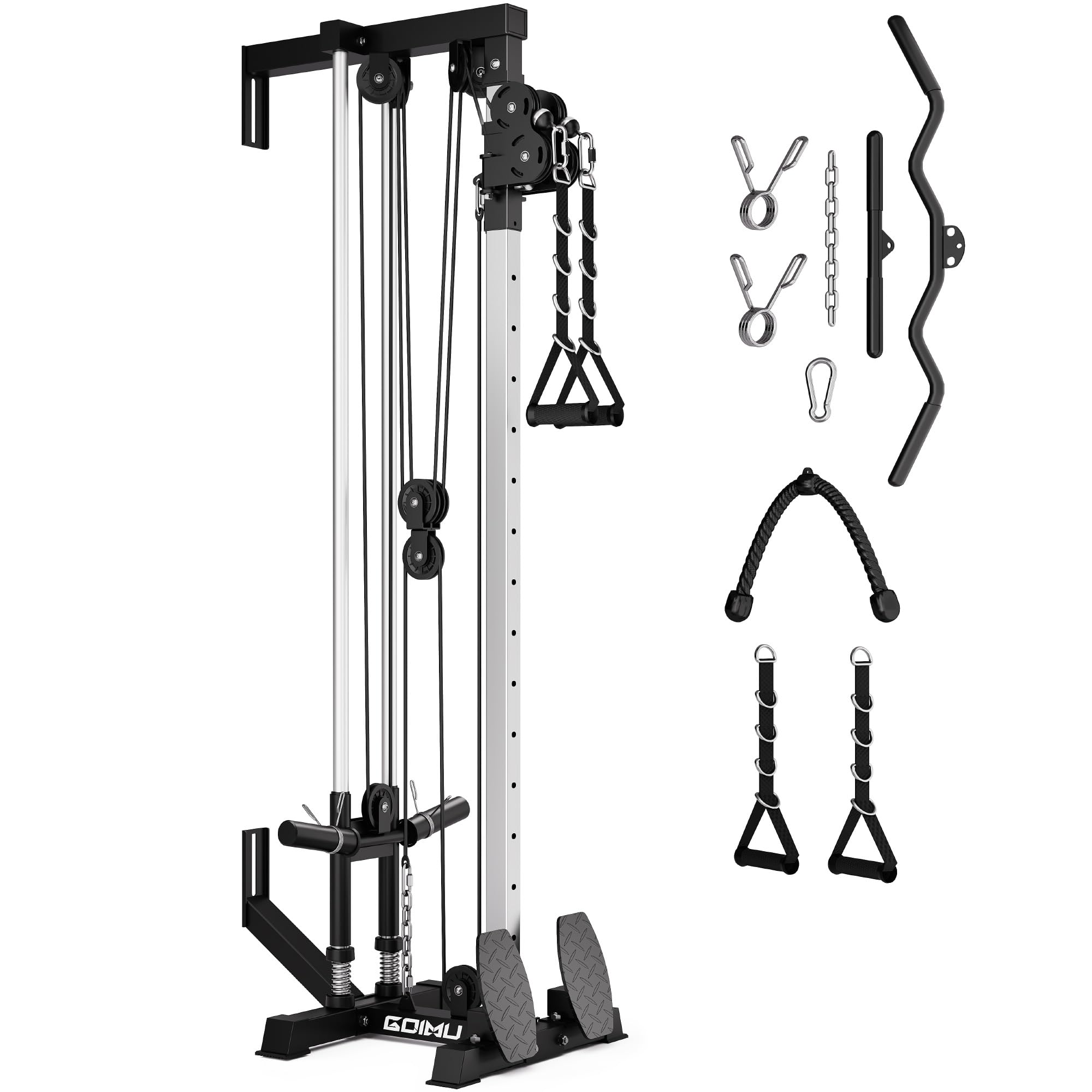
Goimu WM1 Wall Mount

Goimu

Goimu WM1 Wall Mount

  • Footprint 28.11"D x 24.8"W x 78.74"H
  • Wall Type Concrete or masonry
  • Resistance Up to 300 lb
  • Pulley Positions 17 heights
Check Price on Amazon

This is the smallest thing here you can bolt to a wall and still call a cable machine: 24.8 inches wide, 28.11 deep, a little over 3 square feet of footprint. In a garage corner or at the end of a hallway, that number does more work than any other specification on this page.

The feature we did not expect at this end of the range is the ratio adaptor. Move the cable onto the second pulley and the resistance halves, which turns a modest plate load into something usable for long endurance sets; switch back for heavy rows. It is a genuinely useful trick, and it is most of the reason this one stays on the list.

The wall is the catch. Goimu specifies concrete or masonry, so a studded drywall wall is out unless you build a proper mount, and that rules out plenty of apartments before you get to the price. The glide is the other compromise: the carriage wants silicone on the rails to stay smooth, and it will never feel like a weighted stack.

Bottom Line

A clever, genuinely tiny wall station for a masonry wall and a modest budget; the glide is the compromise you are accepting.

Check Latest Price

How We Tested Compact Functional Trainers

We started with a list of every compact trainer we could find that fit a roughly four-foot stretch of wall, then narrowed it by footprint, load system, published range of motion, price, and whether the manufacturer sold replacement cables and pulleys separately. That left seven units, which we bought the way you would.

Each arrived in a box and was assembled by one person with the included tools, on the clock. We noted whether the instruction steps matched the hardware actually in the bag, where a second set of hands became necessary, and how long it took from opening the box to the first set. Once built, we loaded each one with the heaviest weight we'd realistically pull and did slow, heavy rows while watching the feet for lift or slide, then leaned on the uprights between sets to see how much the frame gave.

Pulley smoothness got the most attention because it's what you feel on every rep. We ran single-arm rows and deliberate chest flies at light and heavy loads, listening for grinding or catching, and checked whether the cable tracked evenly at the very top and bottom of the column. We timed moving both handles from high to low, and tried it one-handed at awkward angles, since that's how you actually switch exercises mid-workout. Range of motion was measured at the low pulley: could we get a full stretch on a row without the stack bottoming out? After eight months of four to five sessions a week, we re-checked every cable for fraying, hunted for wobble at the joints, and weighed what each trainer cost against what came in the box.

How to Choose

Measure the wall before the machine

Every pick here stands between 78 and 83 inches tall, which matters more than width in a basement with ductwork or a room with a ceiling fan. Widths run from 25.6 to 62.6 inches and depths from 26.9 to 75, and that spread decides placement: a deep all-in-one wants a corner of its own, while a shallow crossover wants a long wall. Stand where the machine will go and check you can work without stepping back into anything.

Then look up. A lat pulldown needs clearance above the bar, not just above the frame, and an 82-inch machine in a low garage leaves nothing for the pull. Measure floor to the lowest obstruction, subtract the machine height, and keep a few inches for your hands.

Weight stacks versus plate loading

A stack buys speed. Pull a pin and the load changes, which is why drop sets and supersets feel natural on the Inspire FTX and the Body-Solid PFT100. Plate-loaded stations cost less up front and have no ceiling but your plate collection, but you pay for the iron separately and find somewhere to store it. Neither is better; they suit different habits.

Increments deserve as much attention as total weight. A 154-pound stack divided into 12 levels moves in steps that are too big for lateral raises and rotator work, so check the jump between plates if small accessory movements are the point of the machine for you.

Pulley heights and cable travel

Two independently adjustable pulleys are the whole reason to own a functional trainer: a low row on one side and a face pull on the other, set without compromise. Count the positions, since 17 and 19 are typical here, but look at the ends of the range too. The lowest setting should reach floor-level work and the highest should sit above your shoulder for overhead pressing.

Travel matters as much as height, and it is where compact frames give ground. A short cable run shows up in long arcs such as lat pulldowns, where a tall lifter runs out of cable before the set is finished. If long pulls are central to your training, test the reach before you buy.

Wall-mounted or freestanding

A wall station gives you cables with no floor frame at all, which is why the Mikolo and Goimu are the space-savers in this group. The catch is structural. The Goimu specifies concrete or masonry, and every wall unit depends on what it is bolted to, so find your studs or your slab before you order, and plan on leaving it behind when you move.

Freestanding machines need more depth, but they go where you put them and sit happily on a mat. Check the machine weight if the floor above a neighbor is involved, and use the supplied floor-mounting hardware rather than trusting the frame's own footprint.

Assembly is part of the purchase

Cable routing is the step that decides whether a build takes an afternoon or a weekend, and printed instructions are usually the weakest part of the package. Several machines here lean on an assembly video because the paper version does not carry the routing. Clear the floor, sort the hardware by number, and watch the routing section before you start rather than during.

Open the box list before you order attachments, too. Some picks arrive with a rope, bars and handles; the Body-Solid PFT100 arrives as a bare frame, so add what you actually use to the plan.

Frequently Asked Questions

Final Verdict

The Inspire Fitness FTX is the machine we point most people to. Two independent 165-pound stacks, a glide that stays smooth under load, and a 40-inch width that fits a corner of a room you still have to live in. If floor space is tighter than that, the Mikolo wall station delivers dual pulleys with no floor frame at all, as long as your wall can take it.

And if 165 pounds a side is not enough, the Body-Solid PFT100 carries the heaviest stacks here and stays quiet doing it. That is the decision: the corner, the wall, or the weight.