Strength & Weights

Best Cable Machines for a Home Gym of 2026

The appeal of a cable machine at home is simple: you can do lat pulldowns, rows, face pulls, and triceps work without waiting for a rack or driving to the gym. The catch is that a flimsy frame or a sticky pulley makes every rep feel worse than the gym version, and a machine that swallows half the garage is hard to justify. I care about sturdiness first—if the frame walks across the floor during a heavy pulldown, nothing else matters—but smooth operation, sensible size, honest weight capacity, and assembly instructions that don’t require a second person are close behind.

Over eight months, my team and I assembled, loaded, and lived with six home cable machines, from compact plate-loaded options to sturdier frames. We leaned into them for lat pulldowns, seated rows, and cable crossovers, then noted where quality showed up in the welds, pulleys, and hardware. The best ones made the workout feel normal, not like a compromise; the weaker ones reminded us that value isn’t the same as a low sticker price. The picks below are the ones we’d keep using.

Best For Heavy-duty wall mount

Our Score 9.4/10
ER Kang Wall Mount Station

ER

ER Kang Wall Mount Station

  • Frame 11-gauge steel
  • Footprint (D X W) 26 x 27.2 in
  • Max Weight Rating 400 lb
  • Cable Tensile Strength 2,200 lb
Check Price on Amazon

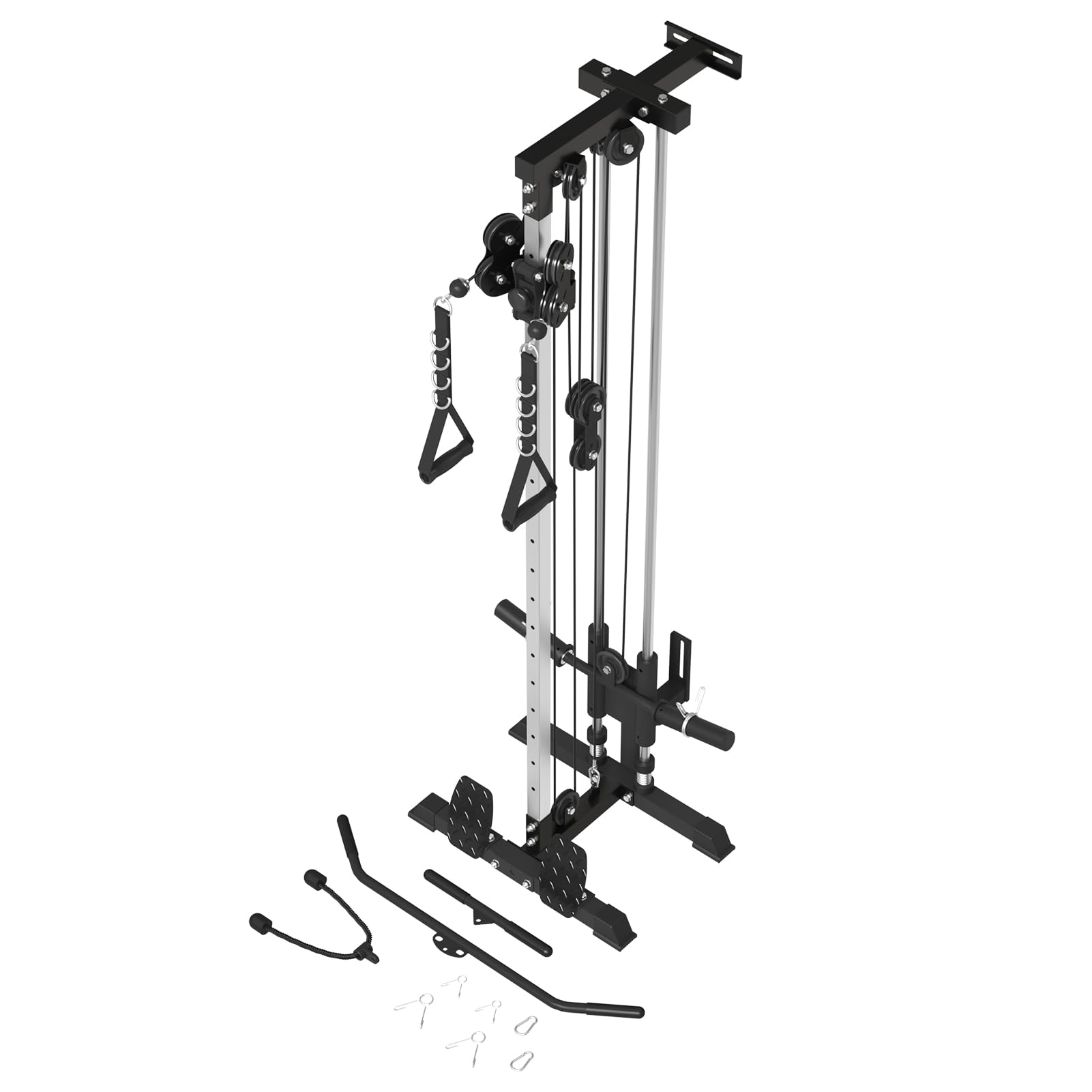
Eleven-gauge steel and cables rated to 2,200 pounds of tensile strength are numbers you expect on a commercial machine, not a wall station that hangs in 26 by 27 inches. That build is the case for the ER Kang: if the machine is going to live on your wall for years, the frame and the cables are the parts you never want to think about again.

The working details are sensible. The base carries a large footboard, so seated rows get a brace for your feet, and the weight peg sits at an upward 10-degree angle to stop plates sliding off between sets. The 400-pound weight recommendation covers most home lifters, and the 81.9-inch column clears an eight-foot ceiling by more than a foot.

Wall stations live or die on installation. Get the column level and the anchors into solid material and the pull stays smooth; skip either and you will feel play in every rep. Budget an afternoon, a level, and a helper for lifting it into place, and check it for square before you load a plate.

Our verdict on this one is conditional but positive. Among the wall-mounted stations here, it is the one we hang when frame strength matters more than extra features, and the single column keeps both the cost and the floor space down. It does rows, pulldowns, curls, and triceps very well. It does not do crossovers, and no amount of hardware will change that.

Bottom Line

A wall station for someone who wants commercial-grade steel and cables, with the footboard and angled peg that make rows and pulldowns easy to live with.

Check Latest Price

Best Overall

Our Score 9.2/10
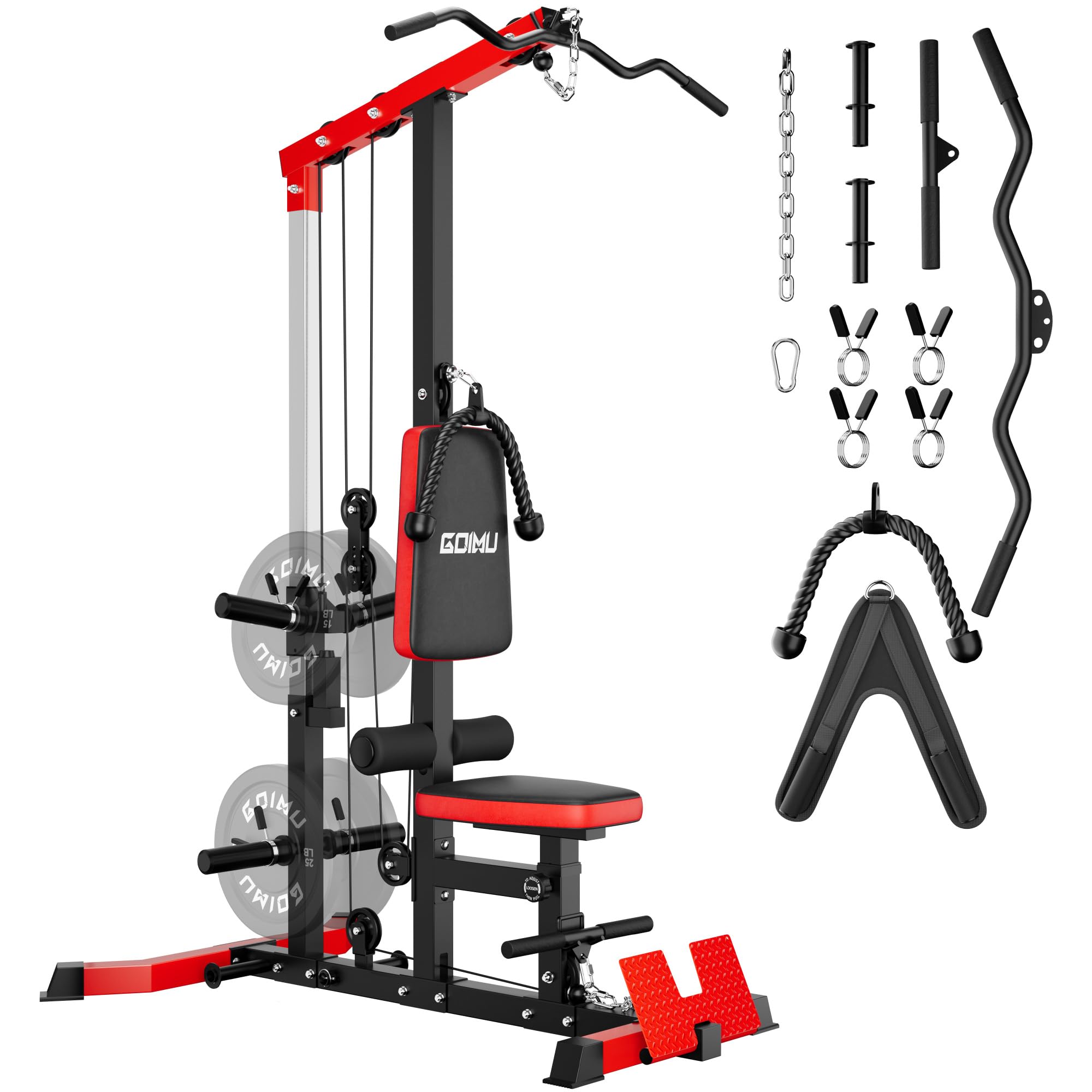
Goimu LS01 Cable Machine

Goimu

Goimu LS01 Cable Machine

  • Footprint 3.12 sq ft
  • Pulley Stations 3 (high, low, ab crunch)
  • Assembled Height 83.46 in
  • Max Weight Rating 800 lb
Check Price on Amazon

Three pulley stations in one freestanding column, with no wall drilling required.

Three pulley stations in a single column is the whole argument for this machine. The high pulley takes lat pulldowns and overhead work, the low pulley turns the same frame into a rowing station, and the included ab strap adds trunk work. For a room that has to cover back, arms, and midsection in one spot, that is the most useful coverage in this group, and we especially like that you get it without putting a hole in a wall.

The 80-pound frame cuts both ways. It is light enough that one person can assemble and reposition it, which matters if your gym shares space with a car, and it is light enough that a rough, snatched pull will move it. Load the plates low, keep the base settled, and the pull stays clean. The 800-pound figure is what the frame is rated to hold, not a suggestion to hang that much on it on day one.

What comes in the box saves a second order: the lat bar, cable bar, tricep rope, ab strap, and band pegs are all included. The padded seat adjusts through three heights, and the leg hold-down is the one place we want another setting — if you are well over six feet, check that your knees fit underneath. Mostly, though, this is a machine that removes excuses: the stations are already there, the attachments are already there, and the work takes ten seconds to start.

Bottom Line

Three pulley stations, a small freestanding footprint, and no wall to drill: this is the one to buy if you want pulldowns, rows, and curls from a single machine.

Check Latest Price

Best Full Cable Crossover

Our Score 9.2/10
Body-Solid Powerline PFT100

Body-Solid

Body-Solid Powerline PFT100

  • Warranty 10 years frame, 1 year parts
  • Weight Stacks Dual, independent
  • Machine Weight 476 lb
  • Footprint (D X W) 42.3 x 62.6 in
Check Price on Amazon

Dual independent stacks and true crossover width for a dedicated home-gym room.

Cable crossovers are the reason to pay for two columns instead of one. A single tower gives you pulldowns and rows; this machine gives you a fly that actually flies, plus independent-arm pressing, upright rows, deltoid raises, and the isolateral work a shared pulley cannot do. The 62.6 inches between the uprights is what makes that possible — width is the feature, not the inconvenience.

We think of the PFT100 as the last big purchase for a garage gym that already has a rack. The dual independent stacks mean you change resistance with a pin between sets instead of walking plates back and forth, and after a few supersets that difference is worth more than any single exercise the machine adds. The 476-pound frame does not shift, the pulleys glide quietly through the stroke, and the 10-year frame warranty is the longest here by a wide margin.

Assembly is a two-person, multi-hour job, and the pulley-routing pages are the part that slows everyone down — watch a build video before you start, and lay the hardware out by step. Do that and the rest is straightforward. This is a machine you buy once and build once, then stop thinking about.

Bottom Line

Buy the Powerline if you want real cable crossovers at home: two independent stacks and 62 inches of width do what no single column can.

Check Latest Price

Best Premium Compact Trainer

Our Score 9.2/10
Inspire Fitness FTX Trainer

Inspire Fitness

Inspire Fitness FTX Trainer

  • Weight Stacks Two 165 lb
  • Machine Weight 544 lb
  • Assembled Height 82 in
  • Footprint (D X W) 54 x 40 in
Check Price on Amazon

Two 165-pound stacks in a 40-inch-wide frame that fits a finished room.

Forty inches wide, against the Powerline's sixty-two, is the number that decides between these two trainers. The FTX is the dual-stack machine you can put in a spare bedroom or a finished basement corner: two 165-pound stacks, a matte black frame, a shelf for your phone, and a rack on the back for the handles. We see it as the trainer for someone who wants gym-quality cable work without dedicating a bay of the garage to it.

Two 165-pound stacks are the honest limit. That is plenty for flys, face pulls, triceps, and one-arm rows, and enough for lat pulldowns for most lifters, but if you are pulling a full stack on seated rows already, you will top out. Take that as the trade for a machine that fits in 54 by 40 inches and can share a room with furniture.

The included kit is generous: a tricep rope, two deluxe D handles, a dual-hook curl bar, a chin/dip belt, and a three-month Centr subscription. At 544 pounds it arrives as a serious delivery and wants two people and an afternoon, which is the price of a frame that will not walk across the floor mid-set.

Bottom Line

The best choice for a finished room: a 40-inch-wide dual-stack trainer that delivers crossover and isolateral work without turning your garage into a gym.

Check Latest Price

Best for Pulldowns and Rows

Our Score 9.2/10
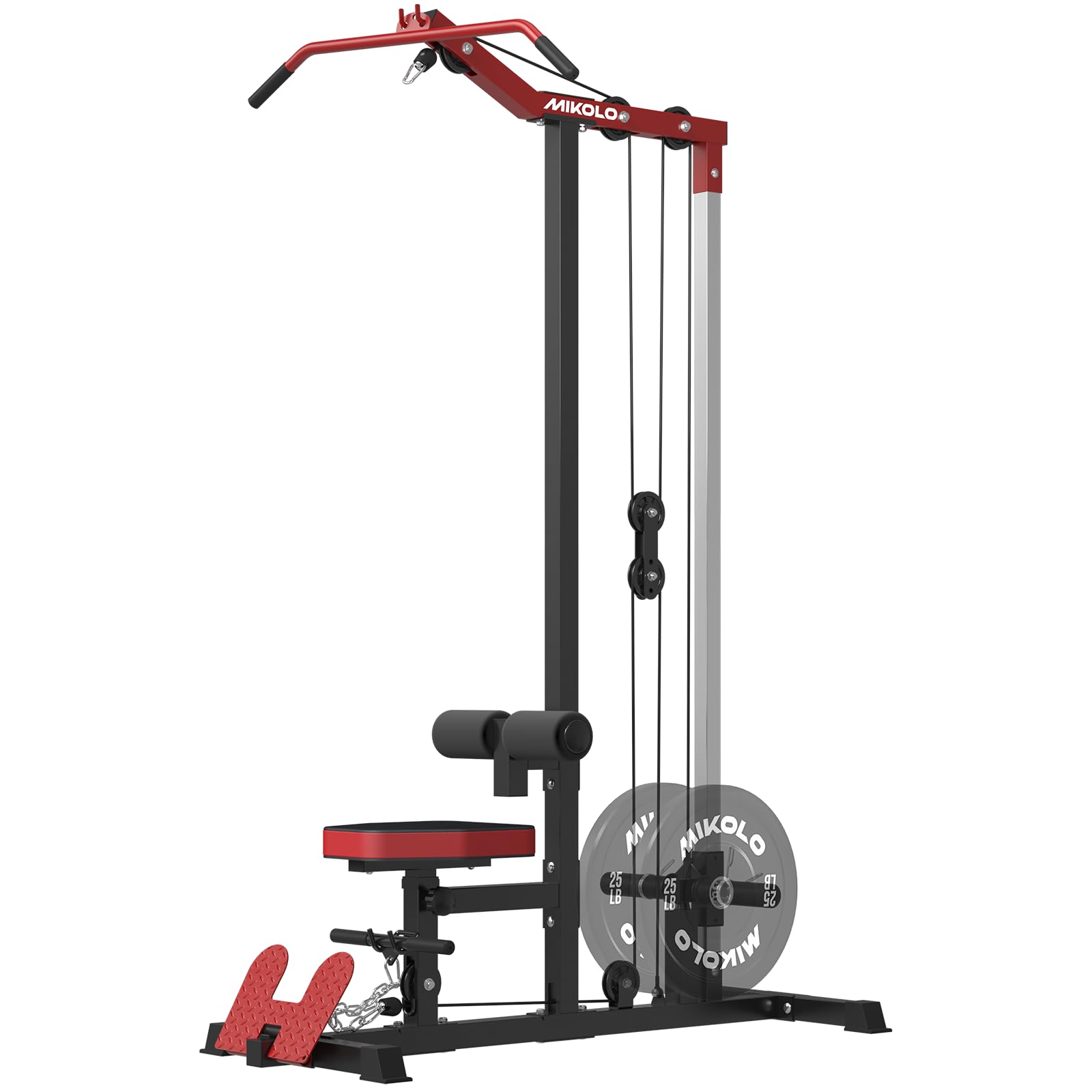
Mikolo LAT Pulldown Machine

Mikolo

Mikolo LAT Pulldown Machine

  • Seat 3 heights, 13 x 18 in
  • Pulleys High and low
  • Footprint 10 sq ft
  • Max Weight Rating 450 lb
Check Price on Amazon

A dedicated high and low pulley tower with a padded seat and 450-pound rating.

If you are well over six feet, the seated pulldown here may feel short, and that is the honest caveat to start with. The tower is built around average reach and the seat adjusts through three heights, but it does not grow. Everyone else gets a very complete pulldown station: a 13-by-18-inch pad, a leg hold-down that keeps you from rising on heavy sets, and a high pulley positioned for a long, straight pull down to the chest.

For the pulldown-and-row job specifically, this is the most complete freestanding tower in this group. The lower pulley turns the frame into a seated row station, the 450-pound rating gives you room to load, and the whole machine weighs 71 pounds and covers a 10-square-foot footprint, so one person can build it and move it. We also like that the lat bar, cable bar, and a pair of clamps come with it — the first workout does not wait on an order.

Because the frame is light, keep your pulls smooth rather than snatched and let the base settle before you go heavy. Assembly is a one-person afternoon, and the pulleys run quiet through the stroke, which is what you want in a machine that will sit in a spare room rather than a garage.

Bottom Line

Choose this tower if pulldowns and rows are the priority: a dedicated high and low pulley, a padded seat, and a 450-pound rating at a modest footprint.

Check Latest Price

Best For Wide crossover work

Our Score 9.2/10
DONOW Cable Crossover Machine

DONOW

DONOW Cable Crossover Machine

  • Pulleys Two, independent
  • Machine Weight Over 250 lb
  • Pulley Positions 16
  • Footprint (D X W) 56 x 79.7 in
Check Price on Amazon

Two columns for about the money of a single tower is the reason this one stays on our list. The DONOW is the least expensive true cable crossover here: two independent pulleys, 16 height positions, and 79.7 inches between the uprights, the widest stance in this group and the closest thing to the range of motion you get from a commercial crossover.

What the independent pulleys buy you is real: cable crossovers, chops, rotational work, and one-arm pressing that a single column can only approximate. The machine is built from commercial-grade steel and weighs more than 250 pounds, so it stays put — and it ships in three boxes, so plan the delivery before the delivery day.

Here is our read. If flys and crossovers are the point and a premium trainer is not happening, this is the machine to buy, with one caveat about plate-loaded crossovers in general: with two pulleys in the cable path, the weight on the pin is not the weight you feel, so you will load heavier than the number suggests and want a deep pile of plates. Buy it for the width and the independence, not for the plate math.

Bottom Line

If crossovers are the goal and a premium trainer is out of reach, this is the roomy two-column machine to get, provided you can give it an 80-inch wall.

Check Latest Price

Best Wall-Mounted Space Saver

Our Score 9.0/10
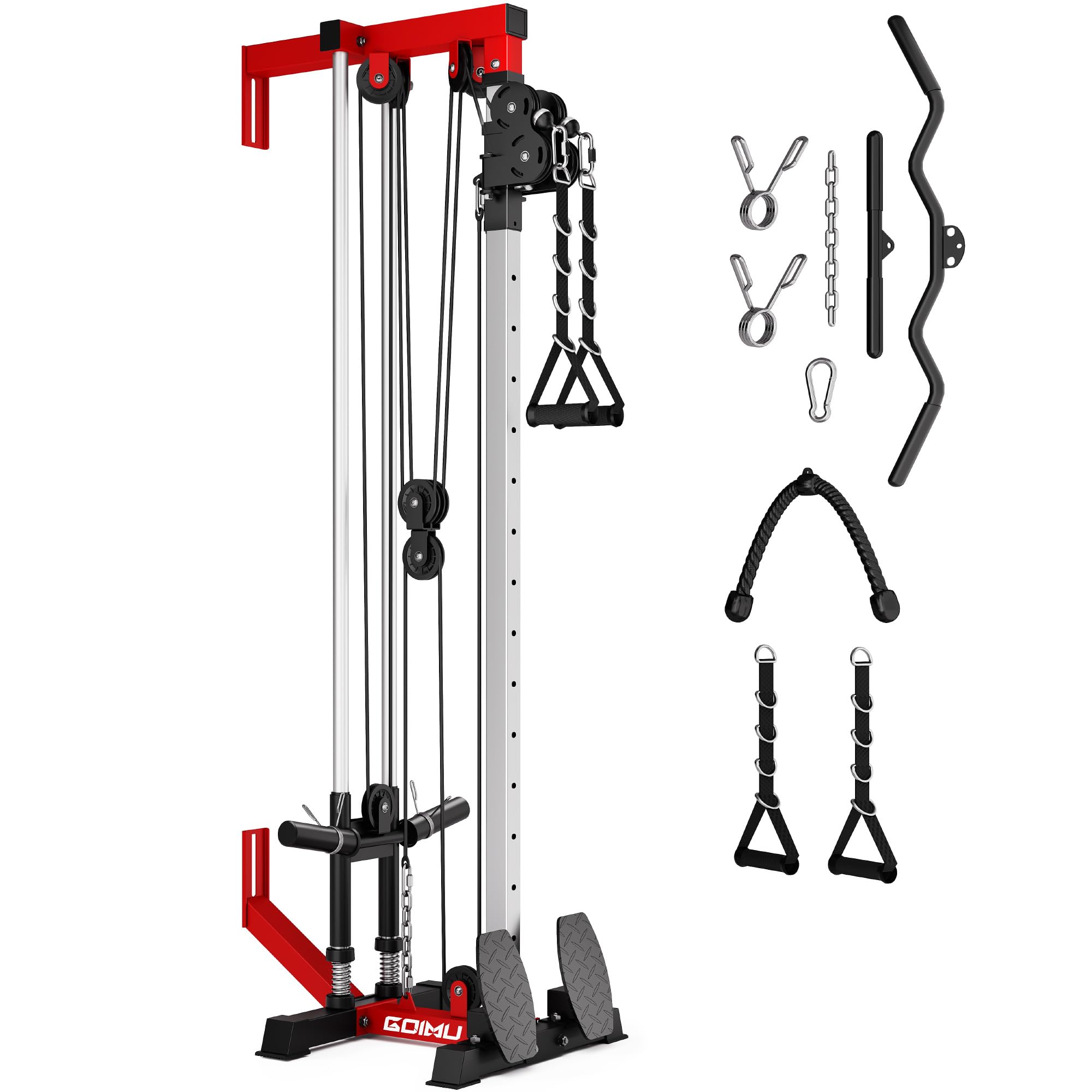
Goimu WM1 Wall Mount Station

Goimu

Goimu WM1 Wall Mount Station

  • Mounting Concrete or masonry wall
  • Pulley Ratio 1:1 and 2:1
  • Pulley Positions 17
  • Max Weight Rating 300 lb
Check Price on Amazon

Bolts to a masonry wall and adds 17 pulley heights without taking floor space.

Before anything else, this station bolts to concrete or masonry, and the listing says so plainly. That single line decides whether it is an option for you. A wood-frame garage wall, a rental, or a room where you cannot drill becomes a no, and no anchor bolt fixes that.

If the wall works, you get a 78.74-inch column with 17 pulley positions, two pulleys, and an adaptor that switches between a 1:1 and a 2:1 ratio. The 2:1 setting doubles the cable travel and halves the felt load, which is what turns a pair of tens into useful resistance for triceps and rear delts. Hardware is organized by step, and the lat bar, T bar, rope, and dual handle come in the box.

The ratio switch is the detail we appreciate most, because it is the difference between a machine that only does heavy and one that does both. Two things to know going in: the pulley wheels are plastic, and an aluminum swap is the first upgrade most people plan, and the column wants a helper and a level for the initial hang. Once it is square and anchored, though, it disappears into the wall and gives you a garage gym that still parks a car.

Bottom Line

For a garage with a masonry wall and no floor to spare, this 17-position station adds high and low cable work in about three square feet.

Check Latest Price

Best For Mixed plate sizes

Our Score 9.0/10
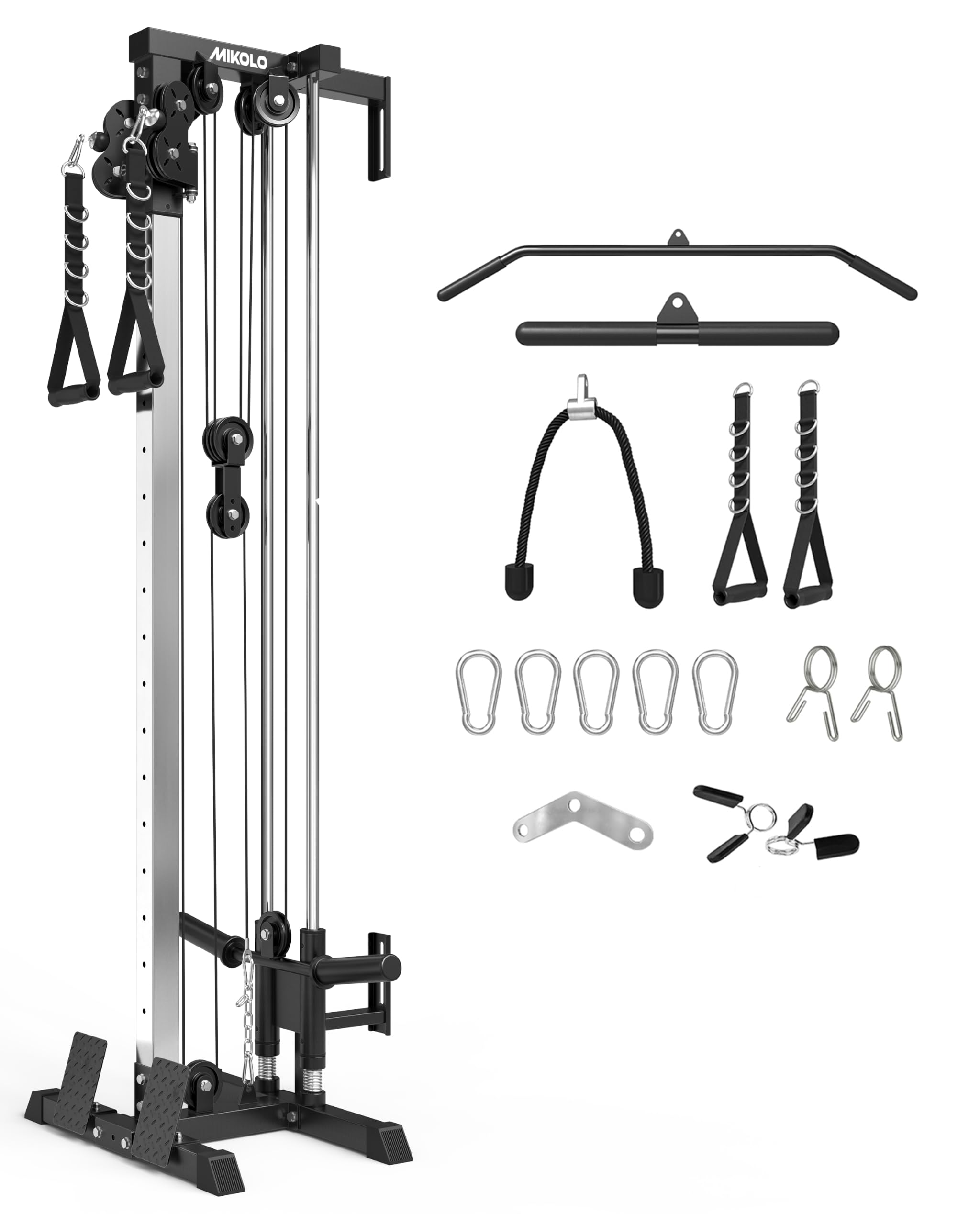
Mikolo M-G3 Wall Mount Station

Mikolo

Mikolo M-G3 Wall Mount Station

  • Plate Sleeves 1 in and 2 in
  • Pulley Positions 19
  • Footprint (D X W) 26.9 x 25.6 in
  • Max Weight Rating 400 lb
Check Price on Amazon

Detachable sleeves that take both 1-inch standard and 2-inch Olympic plates are the small feature that makes this station easy to live with. Most home gyms end up with a mixed pile of plates, and being able to grab whichever one is closest removes a reason to skip the set.

The rest of the specification holds up against anything wall-mounted here: 19 height positions on the dual adjustable pulley, a 2,200-pound cable rating, a 400-pound weight recommendation, a large footboard for seated rows, and upward-angled weight pegs. It arrives with a lat bar, a cable bar, and a tricep rope, and Mikolo backs components with an eight-month replacement service on top of a two-year warranty.

Two things we noticed about living with it. The pulley wheels are plastic, and a little silicone lubricant on the slides and cables makes a visible difference to how smooth the pull feels — treat that as routine upkeep rather than a repair. Cable routing is also the part of assembly that takes the longest, and the video is worth more than the printed pages.

Our take: this is the wall station for someone who already owns plates and wants a lot of machine for the outlay, with the single column as the trade. If the ratio switch for lighter accessory work appeals, the Goimu WM1 is the alternative. Otherwise the M-G3 quietly covers the pulldown, row, and curl work that most home cable setups exist for.

Bottom Line

Pick this wall station if you own a mix of 1-inch and 2-inch plates: 19 pulley positions, a footboard, and a 2,200-pound cable rating on a wall column.

Check Latest Price

How We Tested Home Cable Machines

We started by gathering cable machines sold for home use, then narrowed the shortlist by footprint, claimed weight capacity, pulley system, included attachments, and assembly requirements. We ruled out models with vague specs or footprints that wouldn’t fit a one-car garage bay, and we included a mix of plate-loaded and stack-based designs so the results weren’t skewed by one format.

Six machines made the cut, and we spent eight months with them in a garage gym and a spare-room workout corner. Each machine was assembled by one person using only the supplied instructions, and we tracked how long it took, which steps needed a second set of hands, and whether the manual matched the hardware bag. We then used them for lat pulldowns, seated rows, face pulls, triceps pushdowns, and cable crossovers, loading them progressively and watching for frame sway, cable rub, pulley noise, and whether the machine shifted on the floor.

We also measured footprint and checked machine weight versus ease of repositioning, because a sturdy machine that can’t be moved is a problem in a shared room. Stability got judged at working weight, not just empty: we leaned back into pulldowns and pulled from high and low angles to see if the frame lifted or walked. Smooth operation was about the whole path—whether the cable tracked cleanly, the pulley spun without a catch, and the weight moved without jerking. At the end, we compared what each machine cost against its hardware quality, attachment set, and how often we actually wanted to use it.

How to Choose

Start With the Wall and the Ceiling

Wall-mounted stations are the most space-efficient option here, and one constraint decides them: the wall itself. Where a listing specifies a wall type, it calls for concrete or masonry, which rules out most wood-frame garage walls and nearly every rental. If that is your situation, a freestanding tower is the answer, not a longer anchor bolt.

Ceiling matters just as much. The freestanding and wall-mounted machines in this group run from roughly 79 to 83.5 inches tall, and none of them adjusts down. Measure floor to ceiling before you order, and if you have under seven feet to work with, favor a wall column over a tower.

One Column or Two

Most machines here are a single column: a high pulley, a low pulley, and enough travel for pulldowns, rows, curls, triceps, and one-arm work. That covers what most people buy a cable machine for. What a single column cannot give you is a true cable crossover, because a fly needs two pulleys pulling from opposite sides.

Two-column machines — the DONOW, the Body-Solid, and the Inspire — add crossovers, chops, and isolateral pressing. Ask yourself which half of your training this purchase is for. Back and arms points to a column or a tower; chest and shoulders points to two columns, and the shortlist halves from there.

Plate-Loaded or Weight Stack

Plate-loaded machines use the plates you already own and stay light enough to shift — the freestanding towers here weigh 71 and 80 pounds. The trade is handling plates between sets. Weight stacks change resistance with a pin and add a lot of machine weight: the Inspire carries two 165-pound stacks inside a 544-pound frame. Check stack size against your heaviest pulldown, because a stack is a ceiling you cannot lift past.

Pulley ratio is the other figure worth understanding. A 2:1 setting, like the switch on the Goimu WM1, halves the felt load and doubles the cable travel, turning light plates into useful resistance for arms and rear delts.

Assembly, Fit, and What Wears Out

Threading the cables is the step that slows every build; a video or a second pair of hands turns a frustrating afternoon into a manageable one, and anything over 250 pounds should be a two-person job regardless. Check the seat and leg hold-down range if you are tall, since freestanding towers have a fixed pulldown height. Then read the warranty — it runs from one year on the budget towers to a 10-year frame on the Body-Solid, and it tells you what the maker expects to replace.

Frequently Asked Questions

Final Verdict

The Goimu LS01 is the machine we point most people to: three pulley stations, a footprint you can actually find room for, and no wall to drill. It covers pulldowns, rows, curls, and triceps, which is what most home cable setups are really for.

If you have a masonry wall and no floor to spare, the Goimu WM1 does the same work in about three square feet of wall. And if crossovers are non-negotiable, hold out for two columns — the Body-Solid PFT100 is the one to aim at.