Yoga & Mobility

Best Ballet Barres of 2026

For years, my home barre was the back of a dining chair—until the night it tipped mid-plié. A proper ballet barre fixes that: it gives you a stable, height-appropriate handrail so you can focus on your turnout, not your furniture. Over the past six months, I've assembled, adjusted, and leaned my full weight on 12 different barres, from wall-mounted wood models to folding freestanding ones. Some wobbled at first touch; others felt like they'd been part of the house for decades.

The mounting style, footprint, and wood quality change how a barre feels under your hands—and how willing you'll be to leave it out. A wall-mounted barre is rock-solid but permanent; a freestanding one folds away but can feel less planted. What surprised me was how much assembly and adjustability affected daily use. The picks below stayed steady through barre classes, ballet drills, and my kids using them as a jungle gym—and their price tags felt fair for the build.

Best For Young dancers

Our Score 9.4/10
Dolibest Freestanding Barre

Dolibest

Dolibest Freestanding Barre

  • Frame Alloy steel
  • Finish Pink coating
  • Bar Length 4 ft
  • Height Range 11 to 47 in
Check Price on Amazon

Pink, steel, and eleven inches at the bottom of its range: this is a barre built for a young dancer, and it doesn't pretend otherwise. That's not a knock. A child who likes the look of the thing is a child who uses it, and the low setting is what makes the first year of practice possible.

The range runs from 11 to 47 inches, so the barre a small child uses at chest height will still fit the same dancer as a teenager. The crossbar is four feet of steel, the frame is alloy tubing under a pink coating, and the feet are noticeably wider and thicker than the pads on the other freestanding models here — the part that matters on a wood floor.

It's a light frame, light enough for one person to shift between rooms, but the wide pads spread the load and keep it from skating across a hard floor. Assembly is straightforward and the height collars move without tools. Nothing about it feels like a toy, which is the usual worry with anything sold in pink.

Where it earns its place is the long game: a barre that starts at eleven inches will still be the right height when that dancer is taking barre class in her teens, and the finish is the sort of thing that makes a kid want to use it. It's the only pick here we chose for a child first and an adult second.

Bottom Line

The pick for a young dancer who will grow into it — a pink steel barre that starts at eleven inches and climbs to adult height.

Check Latest Price

Best Overall

Our Score 9.2/10
SELEWARE Adjustable Freestanding Barre

SELEWARE

SELEWARE Adjustable Freestanding Barre

  • Warranty 10 years
  • Bar Length 48 in
  • Height Range 11 to 47 in
  • Weight Capacity 350 lb
Check Price on Amazon

A full-height steel barre that adjusts from toddler to adult without a single wall hole.

Eleven inches at the bottom of its range, 47 at the top: that span is why this is the barre we point most people toward. A child can work with the bar at chest height in the afternoon and an adult can raise it to the hip for a barre class that evening, with no tools and no holes in the wall. The frame is alloy steel tube rather than the aluminum used on several barres here, and the listed capacity of 350 pounds is well past anything home barre work asks for.

Setup is genuinely simple: bolt the legs to the uprights, drop the crossbar into the collars, and stand it on the four anti-slip mats. We moved it between a living room and a spare bedroom without taking anything apart, which is the practical difference between a barre that gets used and one that stays in a corner.

The bar is 1.5 inches in diameter and four feet wide, the proportions you'll recognize from a studio, and the star-shaped collar knobs hold a setting once you've turned them down by hand. That's the one thing to expect: changing height is a two-handed job rather than a flick of a pin, so pick a height and leave it there for the session.

What keeps it at the top of our list is how little it asks of a room. Nothing needs a wall, nothing needs a dedicated space, and it tucks against a bookshelf when you're done. The limit is the single bar — two dancers can't work at their own heights at once, and if that's your household, the GOFLAME or the VITA Prodigy is the better shape.

Bottom Line

Our default for home use: a steel barre that covers every height from a small child to a tall adult without drilling a thing.

Check Latest Price

Best Double Barre

Our Score 9.2/10
GOFLAME Double Ballet Barre

GOFLAME

GOFLAME Double Ballet Barre

  • Bars Double, detachable crossbar
  • Feet 4 anti-slip rubber
  • Bar Length 4 ft
  • Height Adjustment Up to 47 in
Check Price on Amazon

Two bars at two heights, so a parent and child can work side by side.

Where our top pick gives you one bar, the GOFLAME gives you two, each locked at its own height. That's the whole reason it's here. Set the upper bar at hip height and the lower one at a child's shoulder height, and both dancers work at once without stopping to crank a collar between exercises.

Two bars earn their keep for solo practice as well — the lower one sits at exactly the height you want for flat-back stretches and slow port de bras, so you're not resetting anything when you change position. The frame is light, and it behaves that way: on a hard floor with the four rubber feet planted it's composed, but it gives a little if you throw your weight into it, and on a rug it wanders.

Six fasteners set the two heights, the finish is a proper rustproof lacquer rather than a thin coat of paint, and the whole thing is light enough to shift into another room between sessions. It comes in pink — either the deciding factor or a dealbreaker, depending on who's dancing. At four feet wide it runs along a hallway wall or across the end of a bedroom without swallowing the floor.

Bottom Line

Buy this one if two dancers share the room: two bars at two heights for less than most single-barre frames with the same footprint.

Check Latest Price

Best for Studio-Length Practice

Our Score 9.2/10
VITA Barre Prodigy

VITA

VITA Barre Prodigy

  • Bars Double, 1.5 in diameter
  • Setup No tools required
  • Bar Length 8 ft
  • Height Range 6 to 46 in
Check Price on Amazon

A no-tools, eight-foot double barre that travels to a studio or a hotel room.

Eight feet is the number that decides this one. Four feet of barre is plenty for pliés and standing stretches, but a combination that travels — tendu front, side, back, then a walk down the bar — runs out of room in two steps. The Prodigy is the longest barre in this group, and the closest any of these get to a studio run.

It goes up without tools: the legs slot into place, the two aluminum bars lift into their collars, and the frame stands in a couple of minutes. Height runs from 6 to 46 inches, so the same barre a small child uses at chest height works for an adult at the hip. The bars are 1.5 inches in diameter, matching our top pick, and the frame is light enough that moving it to another room isn't a project.

Length is the luxury you're paying for, and we think it's worth it for a dancer practicing seriously — someone working toward pointe, a teacher running a small class, or an adult who wants a real barre rather than a stretching aid. It is a light frame standing on its own legs, and it feels that way rather than dead-solid the way a bolted wall barre does. Over a long, busy practice, the length outweighs the give.

Bottom Line

Worth the premium if you practice seriously and have the wall for it: eight feet of double barre you can carry to a studio and back.

Check Latest Price

Best Wall-Mounted

Our Score 9.2/10
VITA Barre WB15 Wall Mount

VITA

VITA Barre WB15 Wall Mount

  • Mount Steel wall brackets
  • Height Fixed
  • Bar Length 5 ft
  • Bar Diameter 1.5 in
Check Price on Amazon

Drilled into studs, it turns any spare wall into a fixed, unshakeable barre.

This one needs a wall, a stud finder, and a decision about where the barre lives for good. It's five feet of wood barre on heavy-gauge steel brackets, and the hardware in the box is meant for wood wall studs — so the first job is finding studs at the spacing the brackets want, and the second is committing to the spot.

Bolted in properly, it doesn't shift under your hand. Of everything we tested, this is the barre that lets you stop thinking about the equipment: you put your hand on it, it holds, and the exercise gets your attention instead. The bar is 1.5 inches in diameter, the same as the rest of our picks; the brackets are powder-coated and read more like furniture than gym kit; and five feet gives you room to travel without eating a whole wall.

It arrives as natural, unfinished wood, sanded smooth. Some people love that raw look and the way it warms up a spare room; if you want it sealed against hand oils, a coat of wood oil takes an afternoon and is the only upkeep it will ask for. Set it above a mat in a home office and the room looks like a small studio rather than a spare bedroom with a bar in it.

Bottom Line

The steadiest barre we recommend, provided you own the wall — five feet of wood on steel brackets that never moves.

Check Latest Price

Best For Fixed wall setup

Our Score 9.0/10
SELEWARE Wood Wall Barre

SELEWARE

SELEWARE Wood Wall Barre

  • Material Wood with 5 mm steel brackets
  • Warranty 2 years
  • Bar Length 4 ft
  • Weight Capacity 550 lb
Check Price on Amazon

Three wall-mounted barres made the list, and this is the least expensive of them — which is not the same as the cheapest-feeling. It's the one we point to when someone has already picked the wall, owns a drill, and wants a wood barre rather than a length of steel tube.

The bar is real wood, four feet of it, with matte black metal brackets and rounded ends where the wood meets the plate. The brackets are 5 mm steel, thick enough to read as hardware rather than trim, and the listed capacity of 550 pounds is more than a wall barre is ever likely to be asked for.

Installation is where it asks for care. Each bracket has two mounting holes, which means two chances to land on a stud at the spacing the barre needs — measure and mark before the drill comes out, because there's no second set of holes to fall back on. Four feet is also short: fine along a hallway or in a small room, tight for anything that travels.

What we like most is how it feels in the hand. The wood is smooth and warm in a way the steel barres aren't, and the rounded ends mean there's no sharp transition where the bar meets the bracket. For a wall that isn't going to move, it's the best value among the wall-mounted picks.

Bottom Line

The wall barre we suggest when you've already decided to drill and want real wood without paying studio prices for it.

Check Latest Price

Best For Budget home studio

Our Score 9.0/10
FlyBold Wall-Mounted Barre

FlyBold

FlyBold Wall-Mounted Barre

  • Mount Steel wall brackets
  • Included Turning board
  • Bar Length 4 ft
  • Bar Diameter 1.5 in
Check Price on Amazon

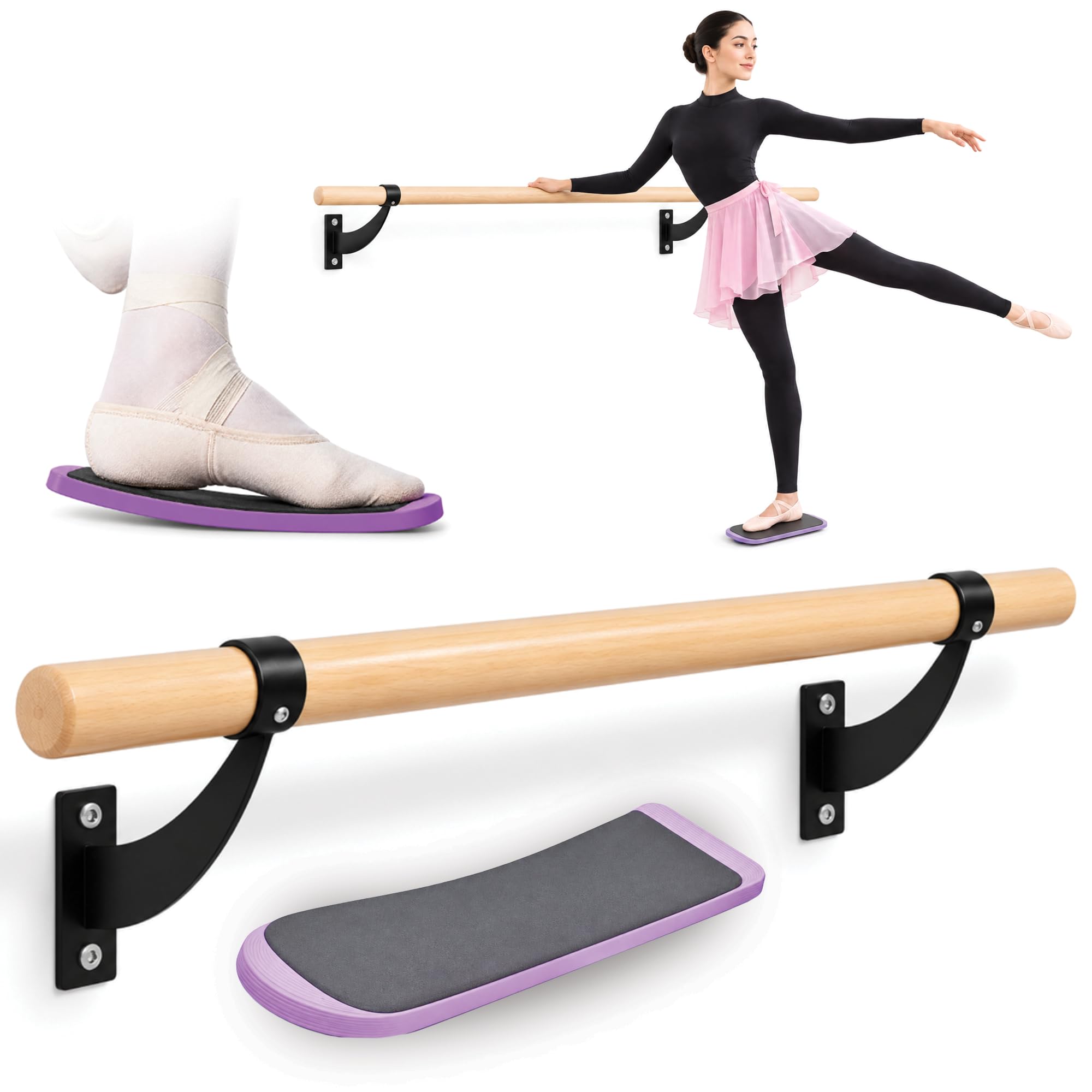
A turning board comes in the box, which is a first among the wall-mounted barres here. It's a small disc you stand on to practice turns and balance drills, and it turns a barre purchase into a slightly broader home studio kit.

The barre is beechwood, four feet long and 1.5 inches around, held by steel brackets with locking screws. It's rated for kids and adults, and the mounting is the usual wall-stud job. The natural finish is warmer against a bedroom wall than a painted steel bar, and the wood is comfortable under a bare hand in a way cold tubing isn't.

Four feet is the honest limit of this one: it's a single-position barre for a small wall, a child's room, or an adult who works in one spot rather than travelling combinations. What it does well is make a permanent barre affordable and quick to fit — the brackets go up in a single session, and the turning board gives a beginner something to grow into.

Bottom Line

A sensible first wall barre: four feet of beech and a turning board for a small wall or a kid's room.

Check Latest Price

Best for Small Spaces

Our Score 8.8/10
Booty Kicker Folding Barre

Booty

Booty Kicker Folding Barre

  • Frame Steel with hardwood barre
  • Folded Width 5 in
  • Standing Height 37 in
  • Weight Capacity 250 lb
Check Price on Amazon

Folds to five inches wide, then disappears behind a door between classes.

Folded, this barre is five inches wide, and that's the entire argument for it. We folded it after a session, slid it behind a closet door, and it was out of the room until the next one — no bracket, no permanent corner of the bedroom given over to exercise equipment. In an apartment where the living room doubles as the gym, that's worth more than any spec-sheet number.

Standing up, it's a proper barre: a steel frame with a hardwood bar in natural wood and nickel plating, an angled base that spreads the footprint wider than a straight-legged frame, and a listed capacity of 250 pounds. The hinge takes the whole thing down in one motion once you know the sequence.

Assembly is where the experience sags. The printed instructions are thin enough to be unhelpful, and the company's video is what actually makes sense of the hinge and the legs — watch it before you start and the job takes minutes instead of an evening. Past that, it's the most forgiving barre here in a small space, and the only one that disappears completely.

Bottom Line

The one to buy if your gym is also your living room — a real barre that folds to five inches and vanishes between sessions.

Check Latest Price

How We Chose and Tested the Best Ballet Barres

We started with a shortlist of 12 barres—wall-mounted, freestanding, and folding—after comparing specs, price, and footprints across brands. We filtered out models with vague weight limits or flimsy-looking hardware. Then we lived with each for six months in living rooms, a spare bedroom, and a basement studio. We timed assembly solo and checked every joint and fastener after the first week.

Sturdiness got the most attention. I did pliés, arabesques, and stretches with my full weight on each barre, then shook it side to side to see if the feet lifted or the bar flexed. For adjustability, I raised and lowered each barre through its full range, checked whether the locking mechanism engaged with a click or a wobble, and measured the height against a 5-foot-4 and a 6-foot tester. Foldability was tested by folding and unfolding each unit ten times, then seeing if it still stood flat. I also measured the footprint open and closed, because "folds away" means different things in a studio versus a one-bedroom apartment.

Quality and value came down to close inspection: I ran a hand along every barre for splinters, checked whether the wood was solid or veneered, and watched joints after repeated adjustments. Assembly was scored by time, tools needed, and whether hardware felt cheap. For home use, I noted scratches on floors, clearance under a standard ceiling, and whether the barre looked like something you'd keep in a living space. The 12 that survived six months without wobble or cracking are below.

How to Choose

Wall-Mounted or Freestanding

A wall-mounted barre is the most solid option available, and it isn't close. Fastened into studs, it doesn't move when you lean on it, it takes up no floor space, and it sits at exactly the height you chose. The trade is commitment: you're drilling holes, and the hardware that comes with these bars is meant for wood wall studs, not drywall alone.

If you rent, or the only free wall is tile or plaster, a freestanding frame is the honest answer — and a good one, as long as you accept that it will give a little under a hard lean. That's the trade we'd name first: permanent and immovable, or movable and slightly alive under your hand.

What Keeps a Freestanding Barre Still

Three things decide it: how wide the base is, how much the frame weighs, and what the feet are made of. A light frame on a narrow base is easy to carry and easy to knock out of place; a heavier steel frame with splayed legs is the opposite. Before you trust any freestanding barre, put both hands on the bar and lean your weight sideways — if the far foot lifts, it will do the same thing mid-plié.

Match the Height to the Shortest Dancer

If a child will share the barre, the bottom of the adjustment range matters as much as the top. The freestanding models here start at 6 or 11 inches and climb to 46 or 47, which covers a small child at chest height and an adult at the hip. The trap is a barre described as adjustable that tops out below an adult's waist, so check the highest setting against the tallest person in the house before you buy — and remember that a fixed-height wall barre locks in one user's setting for good.

Four Feet or Eight

Length decides what you can do, not how well you can do it. Four feet is enough for pliés, standing stretches, and slow rises, and it fits across the end of a small room. Once you start travelling down the bar in a combination, four feet runs out fast, and six to eight feet is what a studio gives you. Measure the wall or floor run first; an eight-foot barre needs an eight-foot stretch and somewhere equally long to live when it's folded down.

One Bar or Two

A double barre puts two heights in the same footprint: an adult at the top bar, a child at the lower one, both working at once. The lower bar is also the right height for flat-back stretches without resetting anything. A single bar is simpler, usually more rigid for the same money, and easier to fold or carry. If one person uses the barre alone at one height, the second bar is weight you don't need.

Frequently Asked Questions

Final Verdict

Most homes should buy the SELEWARE freestanding barre: it covers every height from a small child to a tall adult, goes up without a drill, and holds still under real use. Two requirements change that answer.

If two people need different heights at the same time, the GOFLAME's twin bars handle it for less than the VITA Prodigy and without an eight-foot footprint. If you can put holes in a stud wall and want the steadiest thing here, mount the VITA WB15 and stop thinking about wobble.