Yoga & Mobility

Best Balance Boards for Standing Desks of 2026

I switched to a standing desk the way a lot of people do — with good intentions and no plan for hour four. Standing still is its own kind of uncomfortable: by early afternoon I was rocking hip to hip and leaning on the desk edge like a barstool. A balance board gives your feet a job, and those constant small corrections keep your ankles and hips moving instead of locking. My team has spent eight months with 11 of them, and the gap between a good one and a frustrating one shows up in the first week.

Nobody tells you beforehand that the deck surface and the height matter more than the finish. A board that's too tall or too slick makes your calves ache and your socks slide; one that's too easy becomes a footrest within a month. Difficulty is the trickiest part — you want something that asks a little of your ankles without making typing feel like a circus act. Below are the ones we'd happily keep under our own desks, from a barely-there rock to a proper workout.

Best Overall

Our Score 9.2/10
Yes4All Wooden Wobble Balance Board

Yes4All

Yes4All Wooden Wobble Balance Board

  • Deck Size 15.75 x 15.75 inches
  • Board Weight 3.4 lb
  • Weight Capacity 300 lb
  • Tilt And Rotation 15° tilt and 360° rotation
Check Price on Amazon

A compact 360-degree board that makes standing-desk movement feel natural and easy to live with.

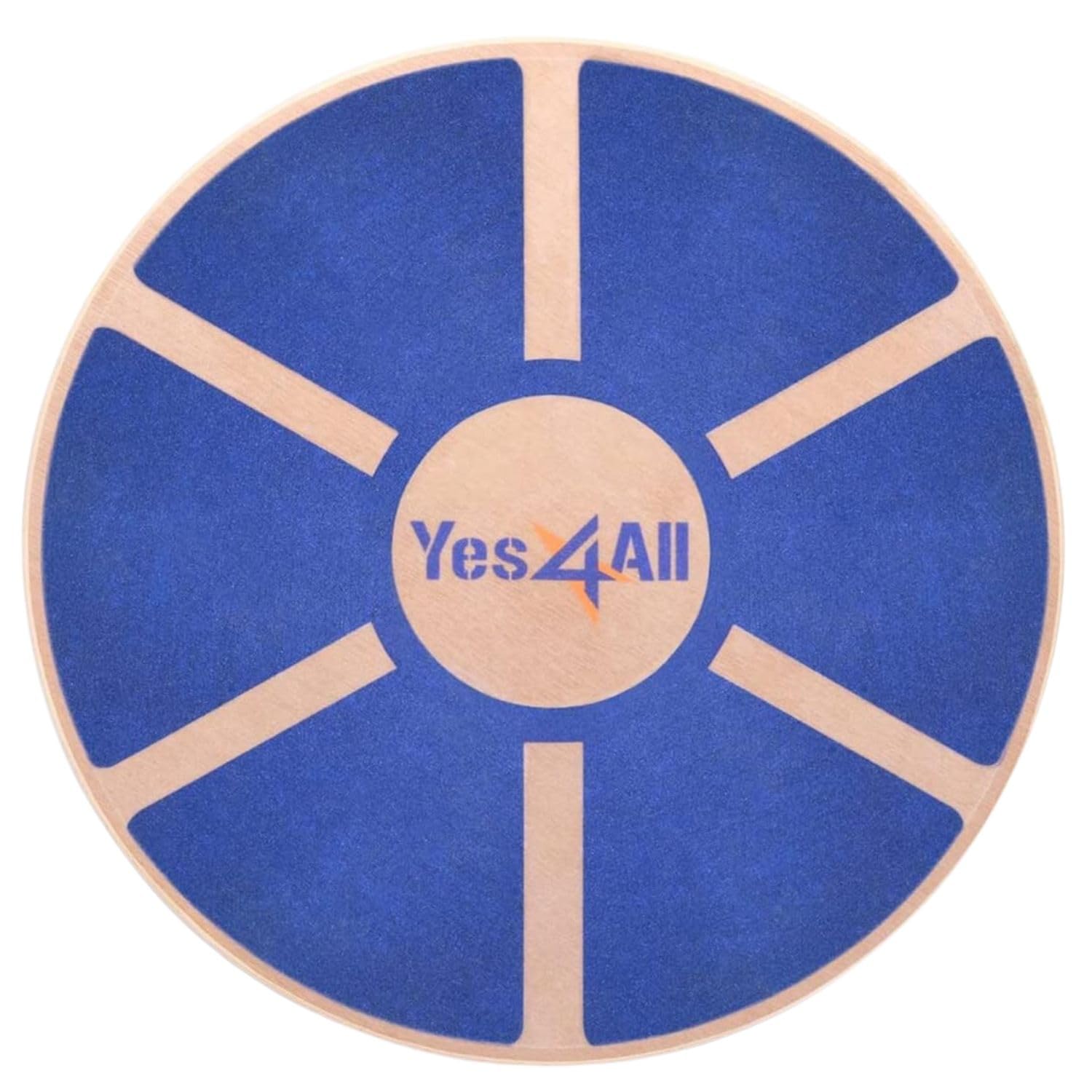
The 15.75-inch round deck is the reason this one became our default for a standing desk: it fits underfoot without swallowing the floor space, and at 3.4 pounds it is easy to nudge aside when you sit. The 15-degree tilt and 360-degree rotation give you more movement than a simple rocker, which we found useful for shifting weight during long stretches at the keyboard. The trade-off is that it asks for a little more control; if you are typing hard, keep the motion small. It is the board we kept by the desk because it does not announce itself.

The wood deck has a sandpaper-like grip that holds socks and shoes, and the underside pad protects the floor. Barefoot, that grit is rough, especially if you use the board for planks or push-ups. On a polished hard floor, the board can also skate, so we put it on a low-pile rug and it stayed put. The 300-pound capacity is generous for a desk board, and the board still feels light enough to move with one foot.

Compared with the FEZIBO, this Yes4All is smaller and less cushioned, but it is also easier to keep out of the way and more affordable. We reach for it when we want a simple, active board rather than a dedicated standing mat. The round shape means you can move front to back and side to side without changing boards; the limitation is that you need to stay aware of your stance. That is the point of the product, and for most desks it is a good trade.

Bottom Line

The compact 360-degree deck makes it our default standing-desk board: it fits underfoot, keeps your legs moving, and stays easy to move aside.

Check Latest Price

Best Rocker Board

Our Score 9.2/10
StrongTek Wooden Balance Board

StrongTek Wooden Balance

StrongTek Wooden Balance Board

  • Deck Size 17.5 x 13.5 inches
  • Board Height 3 inches
  • Board Weight 4.7 lb
  • Weight Capacity 350 lb
Check Price on Amazon

A stable side-to-side rocker for gentle motion without a balancing act.

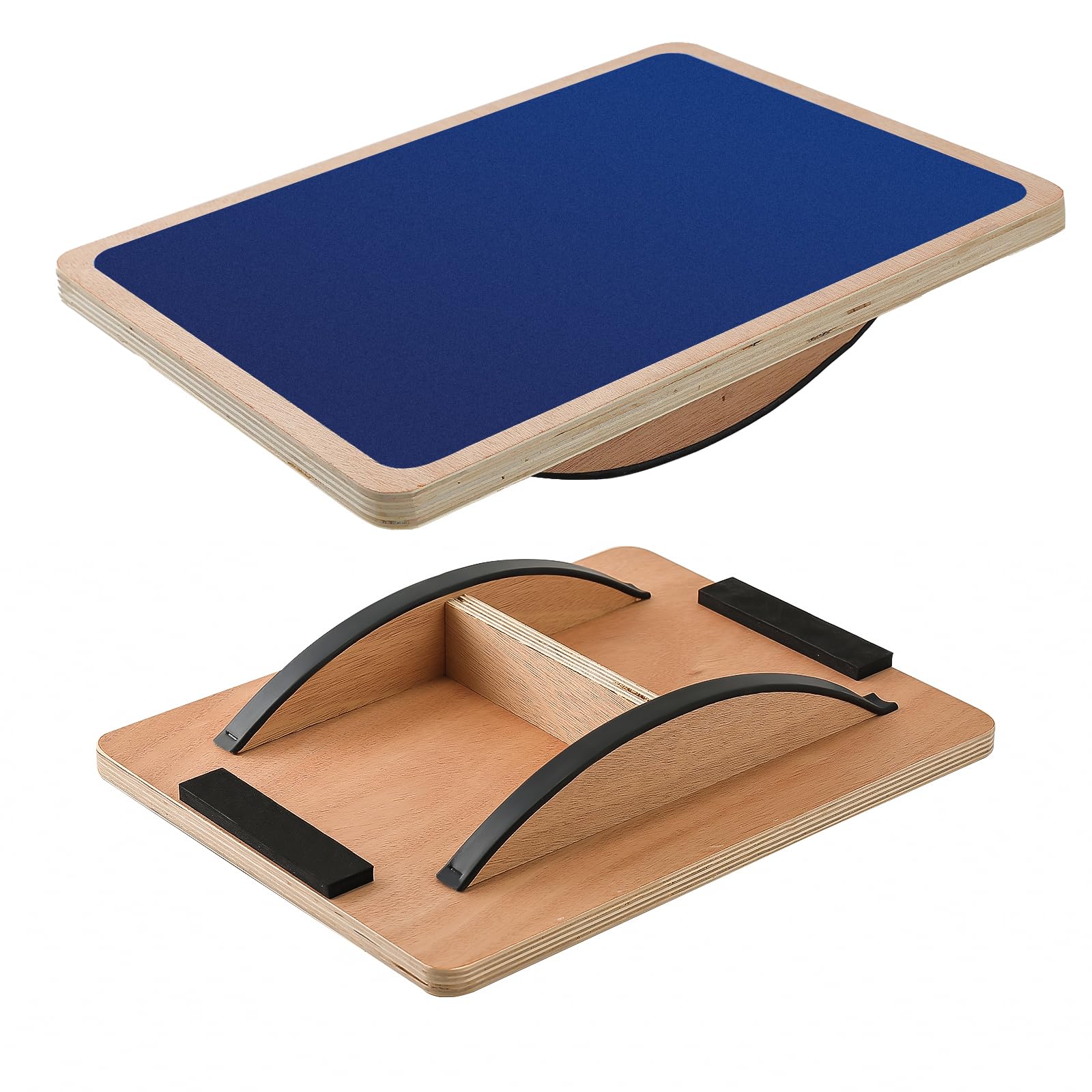
The StrongTek is a rocker board, not a round wobble. Its 17.5-by-13.5-inch deck sits 3 inches high and carries a 350-pound rating. The shape invites a side-to-side rock rather than a full-circle correction, which changes how it feels under a desk.

We found that difference welcome for typing: the board stays quieter underfoot and does not demand as much attention as a 360-degree wobble. The wood deck is solid, the non-slip top holds socks, and the rubber pads keep it from scratching. At 4.7 pounds it is heavy enough to stay put but still easy to move.

The board is at its best for gentle ankle and leg movement, not for someone who wants a serious balance challenge. It is also a better fit for physical-therapy-style rocking than for all-day standing, because the motion is limited compared with a round board. We choose it for a calm desk routine, not for a workout.

Bottom Line

We choose this rocker for calm side-to-side movement while typing, not for a round-board balancing challenge.

Check Latest Price

Best Budget

Our Score 9.2/10
Amazon Basics Wood Wobble Board

Amazon Basics

Amazon Basics Wood Wobble Board

  • Height 3.15 inches
  • Material Wood
  • Deck Size 15.75 x 15.75 inches
  • Weight Capacity 265 lb
Check Price on Amazon

A no-frills round wobble board that gets the desk-movement job done affordably.

The Amazon Basics board is the budget entry in this group, and it looks it: a simple round wood deck, 15.75 inches across, with a sandpaper surface and a 265-pound rating. It is 3.15 inches high. The basics are all present, including a non-slip top and a shape that lets you move in any direction.

We found the deck grippy under socks and shoes, but the grit is rough on bare feet and especially hard on forearms if you use the board for planks. On a smooth floor, the board can slide; a rug or grippy mat makes it more predictable.

As a budget pick, it earns its place because it does the essential job without fuss. It is not as refined as the Yes4All, but it is an easy way to add movement to a desk. We choose it for short standing intervals and simple balance drills, not for a full day of barefoot standing.

Bottom Line

This is the budget board we point to when you want simple wobble movement without a desk-specific shape.

Check Latest Price

Best Compact Wooden Board

Our Score 9.2/10
HAPOO Wooden Wobble Board

HAPOO

HAPOO Wooden Wobble Board

  • Height 2.5 inches
  • Deck Size 16 x 13 inches
  • Board Weight 3.9 lb
  • Weight Capacity 350 lb
Check Price on Amazon

A small wood board with useful grip and floor protection for tight setups.

The HAPOO's most distinctive detail is one you see only when you pick it up: the anti-scratch pads wrap around the bottom edge as well as under the rocker. That matters on hardwood, where a board gets nudged aside with a foot. The deck is 16 by 13 inches and 2.5 inches high, with a 350-pound capacity and a full-surface anti-slip pad. It is a compact wood board rather than a wide platform.

We found the low profile easy to tuck under a desk, and the full-surface grip feels more consistent than a small strip of tape. The board is light enough to move with one foot, and the 350-pound rating is generous for its size. It is also a simple rocker-style wobble, not a 360-degree trainer.

For a small home office or a desk where floor space is tight, that compact shape is the point. It is not the board for someone who wants a big, cushioned platform or a serious balance challenge. We use it for short movement breaks, and we appreciate that the edge pads protect the floor when we do.

Bottom Line

Small spaces suit this compact wooden board, and we appreciate the edge protection and full-surface grip.

Check Latest Price

Best For All-direction wobble

Our Score 9.0/10
ProsourceFit Wooden Balance Board

ProsourceFit Wooden Balance

ProsourceFit Wooden Balance Board

  • Height 2.5 inches
  • Deck Size 15.75 inches diameter
  • Board Weight 3.31 lb
  • Weight Capacity 300 lb
Check Price on Amazon

The ProsourceFit is a 15.75-inch round board with 360-degree rotation, a 300-pound capacity, and a listed weight of 3 pounds. It pairs a solid wood deck with a plastic pivot underneath. The listing also includes a limited lifetime warranty, which is not something every board here carries.

The textured top is more forgiving on bare feet than sandpaper tape, and the board is light enough to move aside easily. Grip is the variable: on a polished hardwood floor, the board can feel slippery, so a rug helps. The plastic pivot and 2.5-inch height make it feel a little less planted than the wood-only boards.

We see it as a good alternative for someone who wants a round wobble board and values the warranty, but it is not the most desk-specific shape here. It is a fair choice for general balance and desk movement, not for therapy.

Bottom Line

A limited lifetime warranty gives this round wobble board our attention, though it is for general desk movement rather than rehabilitation.

Check Latest Price

Best For Tiny desk footprint

Our Score 9.0/10
CanDo Economy Balance Board

CanDo Economy Balance

CanDo Economy Balance Board

  • Height 2 inches
  • Surface Textured with raised circles
  • Deck Size 14 x 14 inches
  • Board Weight 1.25 lb
Check Price on Amazon

The CanDo is the smallest board here: 14 by 14 inches, 2 inches high, and just 1.25 pounds. It is a plastic wobble board with a textured top made of raised circles, and it has no wood or cushioning to speak of. That makes it the one you can tuck under a desk and forget about until you step on it.

The raised circles are the detail that decides whether you like it. They grip socks and shoes, but they press into bare feet; we found it uncomfortable without something between the sole and the plastic. The fix is simple: wear socks or shoes. It is a simple fidget tool rather than a training platform.

The low profile makes it easy to step on and off, and the light weight means it does not feel like a piece of furniture under the desk. It is also the least expensive tier here, which is part of its appeal. It is not a board for serious training, but it is not meant to be.

We choose the CanDo for a tight desk and a small budget, with the expectation that it is a short-session board. It does not have the solid feel of the wood picks, but it also does not take up space. The light weight is the reason it works as a fidget tool: you can move it with one foot without breaking concentration.

Bottom Line

Tight desks and short movement breaks are where we see the tiny plastic board earning its place, with socks or shoes.

Check Latest Price

Best For Beginners and kids

Our Score 9.0/10
Juoe Wooden Balance Board

Juoe Wooden Balance

Juoe Wooden Balance Board

  • Height 3 inches
  • Deck Size 17.5 x 13.5 inches
  • Board Weight 4.5 lb
  • Weight Capacity 350 lb
Check Price on Amazon

Juoe's listing says plainly that this board is not for aggressive tricks or long barefoot standing. The board is 17.5 by 13.5 inches, 3 inches high, and rated to 350 pounds. It has a mild tilt, a wood deck, and a silicone non-slip edge, so it is aimed at beginners, kids, and short balance breaks rather than hard training.

We found it easy to step onto, and the mild tilt makes it less intimidating than a 15-degree round board. It is a board that builds confidence quickly, and the silicone edge gives it a more finished feel than the price suggests.

The size is a mixed bag. The 17.5-inch length gives you room to move, but the 13.5-inch width is not generous for a wide stance. The edge can feel hard under bare feet, and the board is not the one for a long standing session. It is better for a few minutes of rocking than for an all-day desk setup.

That makes the Juoe a family board first and a standing-desk board second. We hand it to a kid or a beginner who needs a gentle introduction, or use it for short breaks at a desk. For a long workday, the wider FEZIBO or the more substantial StrongTek makes more sense.

Bottom Line

We hand this gentle, family-friendly board to beginners and kids, not to anyone after a long barefoot standing session.

Check Latest Price

Best for Dedicated Standing Desks

Our Score 8.8/10
FEZIBO Standing Desk Balance Board

FEZIBO

FEZIBO Standing Desk Balance Board

  • Tilt 8.5 degrees
  • Deck Size 20 x 12 inches
  • Board Weight 6.4 lb
  • Weight Capacity 320 lb
Check Price on Amazon

A wider, purpose-built board with a controlled tilt and room to shift your stance.

The FEZIBO is the most desk-specific board in this group. Its 20-by-12-inch deck and 8.5-degree tilt are designed to let you rock and shift without turning a workday into a balance drill, and we found that lower angle easier to live with than the 15-degree round boards. The 360-degree swing keeps your legs moving, but the motion stays small enough to type through.

The wider platform is the other advantage. It gives you room to change stance, and the wood deck feels more like a standing mat than a gym toy. At 6.4 pounds and 320-pound capacity, it is stable underfoot. It also takes up more floor space than the compact boards, so measure before you commit.

For long stretches at a desk, that wider, gentler platform is worth the extra care. We do not choose it if you need a board you can slide under the desk with one foot; it is a piece you set and leave. The lower tilt is what makes it comfortable for typing, but it also means less of a core challenge than a round wobble. It is a specialist, and a good one.

Bottom Line

For long stretches at a dedicated standing desk, we reach for the wider deck and gentle 8.5-degree tilt.

Check Latest Price

How We Tested Balance Boards Under a Working Desk

We started with a shortlist of roughly 30 boards sold for standing desks and cut it down by reading specs rather than marketing: deck height, weight capacity, footprint, grip surface, and whether the pivot was a fixed rocker, a cushion, or a full 360-degree wobble. Remote workers and office regulars on the team weighed in on what they'd actually leave under a desk all day, and we landed on 11 boards spanning basic rockers to pricier wood-and-bearing models, skipping anything that needed tools to assemble.

Each board spent at least three weeks under a working desk, used in blocks of 20 to 40 minutes through a normal workday. We alternated socks in the morning with sneakers in the afternoon so grip got tested both ways, and typed the same 500-word passages on and off each board, noting whether accuracy dipped or the deck drifted out from under us. Twice a week we logged calf and foot fatigue at the end of the day, sticking to a set standing schedule so comfort comparisons stayed fair.

Durability was mostly a waiting game: eight months of daily use showed which grip tape glazed over or peeled at the corners, which decks creaked, and which bearings developed a grind. We rolled every board under a desk with a rolling chair to see if the footprint caught wheels or shins, and gauged difficulty by handing each one to a teammate who had never used a balance board, timing how long it took before they stopped grabbing the desk. Fun counted for more than we expected — the boards people reached for on a slow afternoon were the ones that felt like play instead of physical therapy. Value came down to whether the money went into the deck and pivot or into the box.

How to Choose

Start with the space under your desk

A balance board lives in the same footprint as your feet, so deck size and height matter more than they do in a gym. The compact boards here run roughly 14 to 17.5 inches across; the FEZIBO is wider at 20 inches. A low deck is easier to step over and less likely to crowd the desk. Measure the floor space you have and check that the board can slide out of the way when you sit. A board you have to wrestle out from under the desk will stop getting used.

Match the motion to your work

Round wobble boards move in every direction, which is great for fidgeting and core engagement but demands more attention. Rocker boards move mainly side to side, making them calmer for typing. The FEZIBO's 8.5-degree tilt is the gentlest here; the round Yes4All and Amazon Basics boards use a 15-degree tilt. If you type through most of your standing time, start with a low-tilt rocker or a board you can keep under control. If you want a more active break, a 360-degree board gives you more to do.

Check grip and floor protection

The top surface needs to hold your feet, and the bottom needs to stay put without scuffing the floor. Sandpaper tape grips well but feels rough on bare feet; textured plastic can be gentler or harsher depending on the pattern. On polished hard floors, even a good board can slide, so a low-pile rug or grippy mat helps. Look for rubber pads or edge protection if you work on wood. The HAPOO's edge pads are a useful detail if you nudge the board aside with a foot.

Decide how long you will stand

A balance board is not an anti-fatigue mat. It keeps you moving, but it does not cushion a long barefoot standing session, and a hard wood deck can become uncomfortable after a while. If you plan to stand for long stretches, a wider, lower-tilt board such as the FEZIBO is easier on the feet than a small plastic puck. If you want a board for short movement breaks, a compact wooden or plastic board is enough. Be honest about session length before you pay for a bigger platform.

Weight, durability, and the base

Check the stated weight capacity against the people who will use it; the boards here range from 265 to 350 pounds. Board weight matters too: a heavier board stays put but is harder to move aside. Durability often shows up at the base, where a pad can peel or a roller can wear. A limited lifetime warranty is a plus, but inspect the bottom and keep the board on a clean, dry floor. If the base starts to separate, stop using it until you can replace the pad or the board.

Frequently Asked Questions

Final Verdict

For most standing desks, the Yes4All Wooden Wobble Balance Board is the one we recommend. It is compact, light enough to move aside, and its 360-degree deck gives you more ways to shift your weight than a simple rocker. The rough grip tape is the trade-off, and a rug solves the floor-grip question.

If you want a calmer side-to-side motion, choose the StrongTek. If you have a dedicated desk and want the widest, most purpose-built platform, the FEZIBO is the better fit, provided you accept the base-wear risk. The Amazon Basics is the budget fallback; the CanDo is for tight spaces and short sessions.