Strength & Weights

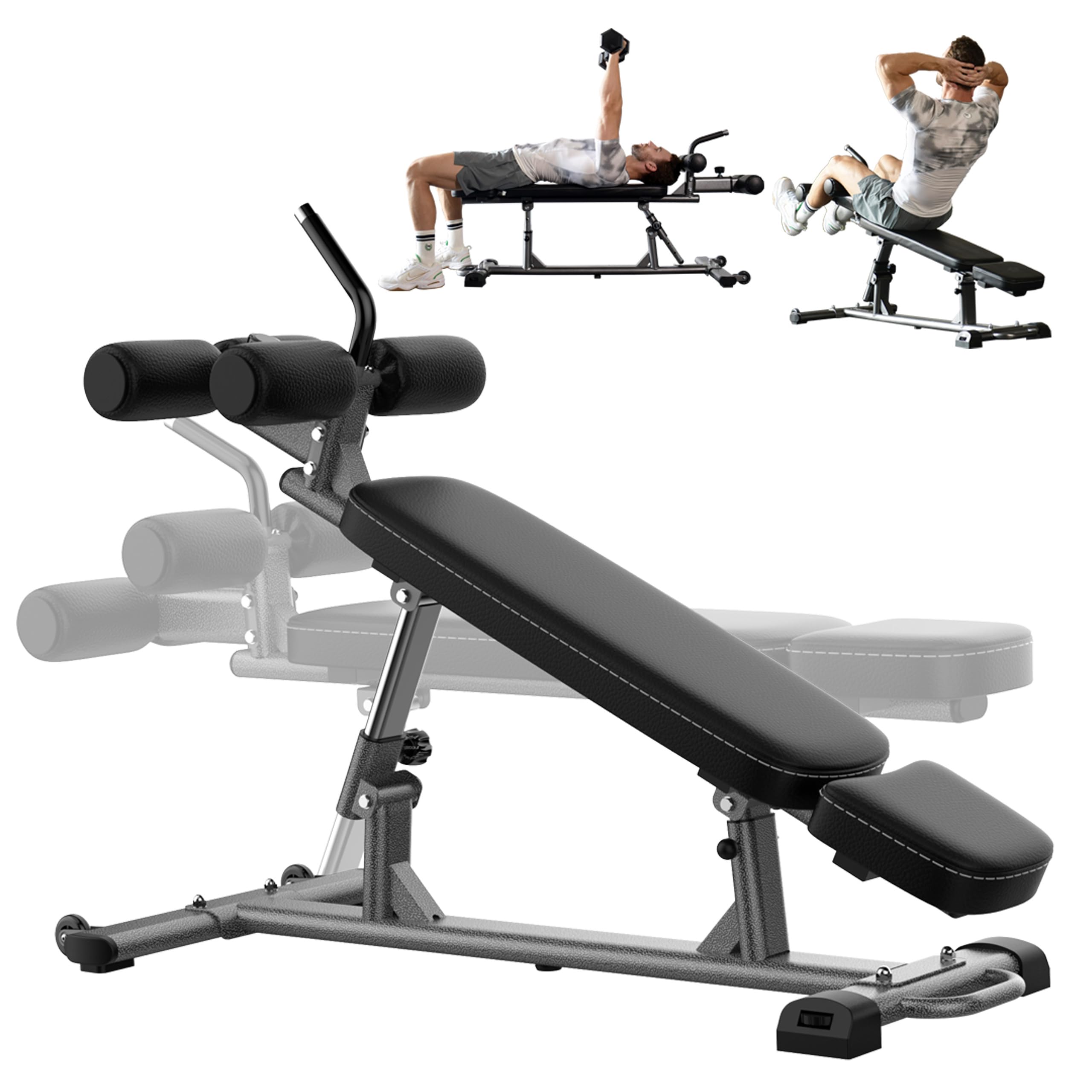
Best Ab Benches of 2026

A crunch on the living room floor works fine until about rep 15, when your lower back arches and your neck takes over the work your abs should be doing. An ab bench pins your hips and back at a fixed angle so the only thing moving is your torso. The catch is that the bench which folds flat and slides under the sofa is often the one that creaks and rocks the moment you add a decline. I've spent six months with 11 of them, and the difference shows up in the first set, not the spec sheet.

Assembly tells you a lot before you ever lie down. I timed how long each bench took to build solo with the tools in the box, and whether the hardware bag matched the steps. Padding is the other thing to press on: too thin and your spine rides the steel, while a backrest that only fits one torso length won't suit a household of two. The picks below run from folding benches that tuck behind a door to heavier adjustable ones that hold a decline for dumbbell work.

Best Overall

Our Score 9.0/10
Marcy SB-4606 Slant Board

Marcy

Marcy SB-4606 Slant Board

  • Folding Yes, locking pin
  • Item Weight 20.1 lb
  • Max User Weight 250 lb
  • Angled Positions 4 incline/decline
Check Price on Amazon

Four angles, a padded backrest with headrest, and it folds flat to store.

Four incline-or-decline positions, a locking pin that folds the whole board flat, and a padded backrest with a foam headrest — that combination is what made the SB-4606 our top pick. The headrest is the detail we didn't expect to care about. At a steep decline you're working upside down, and whether your head has somewhere to rest is the difference between finishing a set and bracing your neck through it.

The four padded handles earn their place for the same reason. Taking hold and pushing yourself back up takes the sting out of the last two reps, and it means you can work closer to the end of a set without wrestling your legs out of the bar. At just over 20 pounds it also folds behind a door or into a closet between sessions, which is how a bench stays in a living room without taking the room over.

Assembly takes about 20 minutes with one snag: the included Allen key doesn't hold the nut side, so have a second wrench or a second pair of hands ready. Set it on firm, level ground — with a heavier user grinding out full-range sit-ups the frame can rock a little, and a flat surface is what keeps that in check. Four separate settings is more adjustment than any other pick here, and it's what keeps the board useful once the novelty wears off.

Bottom Line

The ab bench we recommend to most home gyms: four angles, a long padded backrest, and a fold that gets it out of the room.

Check Latest Price

Best Heavy-Duty

Our Score 8.8/10
Finer Form 1390-V2 Decline Bench

Finer

Finer Form 1390-V2 Decline Bench

  • Positions Flat and decline
  • Item Weight 44 lb
  • Foot Rollers Adjustable
  • Total Weight Capacity 1,100 lb
Check Price on Amazon

A semi-commercial frame that lies flat for presses and declines for crunches.

The 1,100-pound total capacity tells you what this bench is: a semi-commercial frame that happens to do decline sit-ups, not a folding ab board with a weight rating stuck on the end. It weighs 44 pounds and it doesn't fold. We think that's the right trade — the mass is what keeps it planted when you're pressing against it or grinding out a slow reverse crunch.

For a home gym with room for only one bench, that two-in-one design is the whole argument. Flat for dumbbell presses, decline for sit-ups, leg raises and reverse crunches, with a steel handle at the head end that most ab benches simply don't have. The foot rollers adjust for longer legs, the pad runs long enough that a tall torso isn't hanging off the top, and of the picks here this is the one that behaves most like gym equipment.

It isn't flawless. There are wheels for tipping it out of the way and leveling pads at the base, but a slight list to one side and a bit of rock at the joints are worth checking on your own floor before you load it heavily. At the premium end of this group, it makes sense when you want one bench to do two jobs — not when you want the most compact ab station in the house.

Bottom Line

Buy this when one bench has to handle presses and ab work, and the 1,100-pound frame is worth the weight and the price.

Check Latest Price

Best Roman Chair for Small Spaces

Our Score 8.8/10
LifePro SculptTrainer Roman Chair

LifePro

LifePro SculptTrainer Roman Chair

  • Storage Folds flat
  • Footprint 38.2 x 22.2 in
  • Item Weight 19.8 lb
  • Max User Weight 330 lb
Check Price on Amazon

Trains glutes, hamstrings and lower back, then folds flat under a bed.

You don't sit on this one. You lock your ankles under the rollers, drop your hips over the pad and hinge — which is why a Roman chair works your glutes, hamstrings and lower back as hard as your abs. The SculptTrainer does it in 19.8 pounds with a 330-pound capacity: light enough to shift with one hand, rated for far more than most of us will ever load onto it.

What we appreciate most is how small it gets. The frame folds flat enough to slide under a bed or a couch, and the 38-by-22-inch footprint doesn't demand a dedicated corner of the garage. The built-in handles open up the rest of the list — side bends, incline push-ups, tricep dips, preacher curls — so it earns its floor space even in a week when back extensions are all you do on it.

Fitting it takes a few minutes of fiddling with the ankle rollers and the height setting, and the base can end up sitting crooked, so give it a flat floor and check it's square before the first set. If the goal is a core that holds up under load rather than a six-pack of crunches, this is the pick we keep coming back to.

Bottom Line

The one to buy if you want a stronger lower back, glutes and hamstrings rather than a pile of crunches, and you're short on space.

Check Latest Price

Best Budget

Our Score 8.6/10
Marcy JD-1.2 Slant Board

Marcy

Marcy JD-1.2 Slant Board

  • Incline Fixed
  • Backrest Extra-long, high-density foam
  • Max User Weight 300 lb
Check Price on Amazon

A fixed-angle slant board that gets you off the floor for very little.

The JD-1.2 is the cheapest way onto an incline in this group, and that's most of its appeal: a steel frame, an extra-long padded board, foot anchors, and a 300-pound capacity for less than the folding boards cost. Nothing about it adjusts, and for plenty of people that's fine — a slant board has one job.

The fixed angle takes a little ingenuity if you want it steeper; propping the low end on a sturdy block still works, and plenty of home setups do exactly that. What you get in return is a board that doesn't move under you, which is the thing cheap benches usually get wrong. What it doesn't give you is a folding frame, so it wants a permanent spot against a wall rather than a corner of the closet.

Bottom Line

The budget buy we still recommend: a fixed-angle board that gets you off the floor and doesn't shift under you.

Check Latest Price

Best For Full-body circuits

Our Score 8.4/10
Sunny SF-BH625080 Roman Chair

Sunny

Sunny SF-BH625080 Roman Chair

  • Positions Flat to decline
  • Item Weight 24.5 lb
  • Ankle Rollers Adjustable
  • Max User Weight 1,000 lb
Check Price on Amazon

The first thing to sort out with the SF-BH625080 is height. The frame runs tall and the pad sits high, and shorter users are the ones who feel it — if your hips don't clear the pad cleanly, you spend the set fighting the bench instead of loading your lower back. The rollers adjust for leg length, but frame height is frame height, so check where the pad meets your hip crease before you commit.

What it gets right is the range of work and the support under your hips. Back extensions, decline sit-ups, Russian twists, side bends, preacher curls, dumbbell rows — and the foot rest doubles as a calf-raise block, which is a nicer touch than it sounds on a machine this size. A back extension only works if you can relax into the pad, and the padding and angle here let you, which is why it holds a place in this group despite the caveats.

The split seat pad leaves a narrow gap at the center, so set your hips deliberately before you hinge rather than sliding into position mid-set. And at 24.5 pounds with a 1,000-pound rating, the joints can wobble under a fast rep — slow the tempo down and keep it on a hard floor. That's the trade for a machine that folds, does this many exercises, and still costs less than most of the field.

Bottom Line

A genuinely versatile Roman chair with excellent back support, provided you're tall enough for the frame and keep the tempo deliberate.

Check Latest Price

How We Chose and Tested the Ab Benches

We started by pulling every ab bench we could find from the major home gym names, then cut the list on the things that matter before you ever lie down: whether the backrest adjusts through a genuine incline-to-decline range, the stated weight limit, the folded footprint, and how often customer reviews mentioned wobble or hardware that arrived short. That left 11 benches, which we used for six months across a living room rug, a carpeted basement, and a garage on a rubber mat. Each one got the same routine — crunches, decline sit-ups with a dumbbell at the chest, leg raises on the rollers, and enough folding and unfolding to see whether the hinge loosened.

Stability showed up fastest on carpet, where a narrow base would rock sideways mid-crunch and force me to re-plant my feet between sets. To check sturdiness, I loaded each bench past the weight of our heaviest tester and watched the joint where the backrest meets the spine for flex or creak. Fit came down to the leg rollers and handles: on several benches the rollers sat too close to the seat for a 5-foot-2 tester to get full range, and on others the handles were too far forward for anyone over six feet to grab comfortably.

Assembly was timed solo with whatever tools came in the box, and I noted whether the pre-drilled holes lined up without forcing a bolt. Once built, I moved the backrest between positions mid-set to see if the pin slid in one-handed, counted the usable incline and decline stops, and pressed hard into the padding to feel where it bottomed out — a few left my hip bones sore after three sets. We also dragged each bench in and out of storage and used it for dumbbell rows and incline presses, since a bench that only does one movement is hard to justify keeping around.

How to Choose

Decide How Much Angle Adjustment You Need

An ab bench does one mechanical thing: it holds your torso at an angle and anchors your legs, so a crunch becomes a movement you can load instead of a scramble on the floor. More angle means more range and more demand — a deep decline is harder to control on the way down, which is the entire point of it. Four settings, as on the Marcy SB-4606, let you start shallow and progress; a fixed board, like the Marcy JD-1.2, is cheaper and simpler if you already know the angle you like.

The trap is assuming more positions is automatically better. Check that the locking pin seats fully and that the backrest still supports your head at the steepest setting. A short pad on a deep decline leaves your neck doing the work your abs showed up for.

Read Past the Weight Rating to the Frame

Capacity figures in this group run from 250 to 1,100 pounds, and they tell you something about the steel — but not everything about stability. Two benches with the same rating can behave differently under a fast set: mass, base width and the way the feet meet the floor decide whether the thing stays put. The Finer Form 1390-V2 weighs 44 pounds and doesn't fold, which is a nuisance to move and exactly why it feels planted. The folding boards sit near 20 pounds and can rock at full range on a soft floor.

If you're anywhere near a bench's stated limit, buy more frame than you think you need and put it on a hard, level surface. A thin mat over hardwood is worth the few dollars; thick carpet is not your friend.

Fit the Bench to Your Body, Not Just the Room

Two measurements matter more than the footprint: backrest length and where the ankle rollers sit. A tall torso hanging off the top of a short pad turns a crunch into a neck exercise, while ankle pads that won't spread far enough leave your legs taking the load instead of your abs. Roman chairs add a third thing to check — pad height. The Sunny SF-BH625080 runs tall and suits longer legs, while the LifePro SculptTrainer adjusts through a range of heights and folds into a smaller footprint.

Compact in a listing describes the footprint, not whether you fit on it. Sit on the bench you're considering at the pad height you'll actually use before you decide.

Storage, Assembly, and Whether You'll Actually Use It

An ab bench only works if it's out and ready. A folding pin and a 20-pound frame mean the board lives behind a door and comes out for ten minutes — a genuine advantage over a 44-pound bench that has to stay where it lands. If you have a permanent spot for one, buy the heavier bench and enjoy the stability it buys.

Most of these go together in 15 to 30 minutes with the hardware in the box. Build it on a hard floor, then re-tighten the frame bolts after the first few sessions; that's the point where a bench either settles down or starts to rock.

Frequently Asked Questions

Final Verdict

The Marcy SB-4606 is the bench we point most people to: four angles, a backrest long enough to support your head at a decline, padded handles that help you finish a set, and a locking pin that gets the whole thing out of the way. Its 250-pound limit is the one thing that rules it out for bigger users.

Above that weight, or if you want one bench that presses and crunches, the Finer Form 1390-V2 is the buy. For back extensions in a small apartment, the LifePro SculptTrainer is the better tool — and the one most likely to still be out of the closet in six months.